Cost of Living in Cyprus 2026: €1,200/month for a Single Person

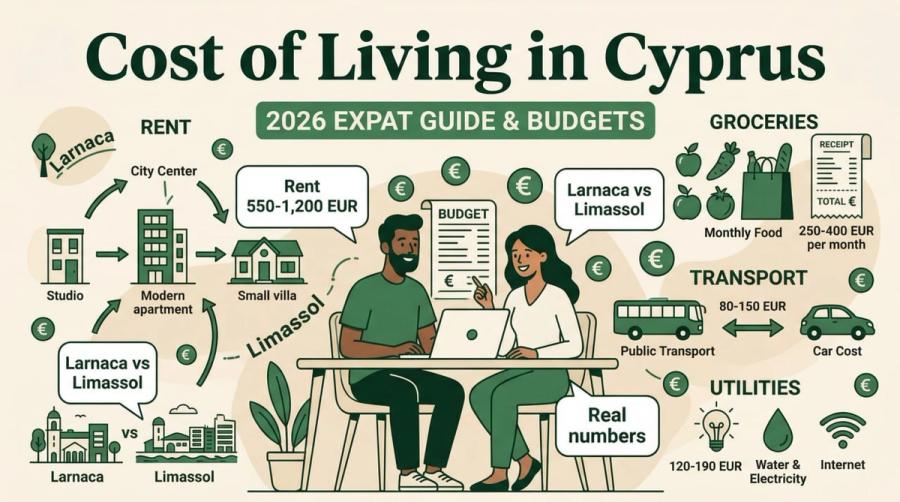
What Does It Really Cost to Live in Cyprus in 2026?
**What Does It Really Cost to Live in Cyprus in 2026?**
Living costs in Cyprus average EUR 1,200-1,800 monthly for a single person outside Nicosia, EUR 1,500-2,200 in the capital. Rent dominates expenses: EUR 600-900 for a one-bedroom apartment centrally, EUR 400-700 outside town. Utilities run EUR 80-150 monthly. Groceries cost EUR 250-350 per person. Dining out averages EUR 8-12 per meal. Healthcare and transport are relatively affordable. These figures reflect actual resident spending, not marketing estimates.
The cost of living in Cyprus varies significantly depending on where you settle. Larnaca is the most affordable coastal city. Limassol is the most expensive. Paphos falls somewhere in between but leans affordable, especially outside the tourist strip. Nicosia, the capital, offers lower rents than Limassol but fewer beach days.
This guide breaks down every major expense category with real EUR figures for 2026, compares Cyprus to other popular expat destinations, and gives you monthly budget templates you can actually use.
According to Eurostat price level data, Cyprus consumer prices are approximately 20% below the EU-27 average and 30-35% below Germany and the UK specifically. Eurostat comparative price levels 2025 confirm Cyprus as one of the more affordable EU member states for day-to-day expenses.
Rent: The Biggest Variable
Rent is your single largest expense in Cyprus, with prices rising steadily since 2022. Monthly costs for a furnished apartment in 2026 range as follows:
Larnaca:
- 1-bedroom apartment (city center): 550 to 750 EUR
- 2-bedroom apartment (city center): 750 to 1,100 EUR
- 1-bedroom (outside center): 450 to 600 EUR
Limassol:
- 1-bedroom apartment (city center): 800 to 1,200 EUR
- 2-bedroom apartment (city center): 1,100 to 1,800 EUR
- 1-bedroom (outside center): 600 to 900 EUR
Paphos:
- 1-bedroom apartment (city center): 500 to 700 EUR
- 2-bedroom apartment (city center): 700 to 1,000 EUR
- 1-bedroom (outside center): 400 to 550 EUR
Nicosia:
- 1-bedroom apartment (city center): 500 to 800 EUR
- 2-bedroom apartment (city center): 700 to 1,100 EUR
- 1-bedroom (outside center): 400 to 600 EUR
Utilities are not included in most rentals. Expect to add 80 to 150 EUR per month for electricity, water, and heating/cooling. Summer air conditioning is the biggest variable. A hot July can push your electricity bill above 200 EUR if you run AC all day.
Groceries and Food
Budget 250-350 EUR monthly for groceries if you're a single person spending carefully, or 400-550 EUR for a couple. Prices are reasonable but not cheap by Southern European standards.
Here are typical prices in 2026:
- Milk (1 liter): 1.50 EUR
- Bread (loaf): 1.20 to 2.00 EUR
- Eggs (12): 3.00 to 3.80 EUR
- Chicken breast (1 kg): 7.00 to 9.00 EUR
- Rice (1 kg): 1.50 to 2.50 EUR
- Tomatoes (1 kg): 1.50 to 3.00 EUR (seasonal)
- Local cheese (halloumi, 250g): 3.50 to 5.00 EUR
- Olive oil (1 liter): 7.00 to 10.00 EUR
- Beer (domestic, 0.5l): 1.50 to 2.50 EUR
- Wine (decent bottle): 5.00 to 10.00 EUR
Dining out is where Cyprus offers great value. A meal at a local taverna costs 10 to 15 EUR per person. A meze (multiple small dishes, enough for two) runs 15 to 20 EUR per person. A coffee at a cafe is 2.50 to 4.00 EUR. Fast food meals cost 6 to 9 EUR.
If you eat out three to four times per week, add another 200 to 300 EUR to your monthly food budget.
Transport
Car ownership dominates among Cyprus expats due to limited public transport outside Nicosia and Limassol. Bus fares cost 1.50 EUR per trip or 40 EUR monthly, but routes run infrequently with sparse coverage. Most rely on personal vehicles for practical daily mobility.
Car-related costs:
- Used car purchase: 5,000 to 15,000 EUR (a decent 3 to 5 year old car)
- Fuel: 1.30 to 1.50 EUR per liter
- Car insurance: 300 to 600 EUR per year
- Annual road tax: 100 to 300 EUR depending on emissions
- Monthly fuel budget: 80 to 150 EUR for typical use
Taxis are available but expensive for daily use. A 10-minute ride costs about 8 to 12 EUR. Bolt operates in the main cities and is slightly cheaper.
Healthcare
Cyprus operates both public and private healthcare systems. The General Healthcare System (GHS, or GeSY in Greek) has provided universal coverage since 2019, funded through payroll contributions at a rate of 2.65% (maximum EUR 4,770 annually).
If you are employed or self-employed and registered with GHS, your basic healthcare is covered with minimal co-payments:
- GP visit: free
- Specialist visit: 6 EUR co-payment
- Hospital stay: free
- Prescriptions: 1 EUR co-payment per item (most medications)
Private healthcare remains popular for shorter wait times. A private GP visit costs 30 to 50 EUR. A specialist consultation costs 50 to 100 EUR. Private health insurance plans run 50 to 150 EUR per month depending on coverage and age.
Internet and Mobile
Fiber internet is available in most urban areas of Cyprus. Connection speeds and reliability continue to improve across the island.
- Home internet (fiber, 100+ Mbps): 30 to 45 EUR per month
- Mobile plan (10GB+ data): 15 to 25 EUR per month
- Combined packages: some providers offer bundles for 50 to 60 EUR
The main providers are Cyta (state-owned, reliable), Epic, and Primetel. Coverage in cities is solid. Rural areas may have slower options.
Monthly Budget Breakdown: Single Person
A single expat in Larnaca or Paphos needs roughly EUR 1,200-1,500 monthly for moderate living. Rent (EUR 400-600), utilities (EUR 80-120), groceries (EUR 200-250), transport (EUR 30-50), dining out (EUR 150-200), and entertainment (EUR 100-150) form the core expenses. Internet costs EUR 20-30, gym membership EUR 30-40, and insurance EUR 50-80. Personal care and miscellaneous add EUR 80-100. Total varies by lifestyle choices and neighborhood selection.
- Rent (1-bed, city center): 600 EUR
- Utilities (electricity, water, internet): 120 EUR
- Groceries: 300 EUR
- Dining out (3x/week): 200 EUR
- Transport (car fuel + insurance): 130 EUR
- Mobile phone: 20 EUR
- Healthcare (GHS covered, minimal extra): 30 EUR
- Entertainment and misc: 150 EUR
- Total: approximately 1,550 EUR per month
For Limassol, add 200 to 400 EUR mainly due to higher rent.
Monthly Budget Breakdown: Couple
A couple living in Larnaca or Paphos:
- Rent (2-bed, city center): 900 EUR
- Utilities: 150 EUR
- Groceries: 450 EUR
- Dining out: 300 EUR
- Transport (one car): 130 EUR
- Mobile phones (2): 35 EUR
- Healthcare: 50 EUR
- Entertainment and misc: 200 EUR
- Total: approximately 2,215 EUR per month
How Does Cyprus Compare?
Cyprus has a lower cost of living than most of Western Europe, though it's not the cheapest option in the Mediterranean.
Cyprus vs Spain: Spain is slightly cheaper for groceries and dining in most regions, but rent in Barcelona or Madrid exceeds Limassol. Smaller Spanish cities (Valencia, Malaga) are comparable to Larnaca. Overall, very similar total costs, but Cyprus wins on taxes for Non-Dom residents.
Cyprus vs UK: The UK is significantly more expensive. London is in another league entirely, but even cities like Manchester or Birmingham cost 30 to 50% more than Cyprus for equivalent lifestyles. Groceries are similar, but rent and transport are much higher in the UK.
Cyprus vs Germany: Germany offers higher salaries but higher costs across the board. Rent in Munich or Frankfurt dwarfs Limassol. Even mid-sized German cities cost 20 to 30% more than Cyprus. Healthcare in Germany is excellent but comes with higher mandatory contributions.
Cyprus vs Portugal: Portugal (Lisbon, Porto) has become increasingly expensive since 2020. The Algarve is comparable to Paphos. Overall, Portugal and Cyprus are in a similar price range, but Cyprus offers better tax incentives for entrepreneurs.
Living Costs Cyprus 2026: What Has Changed
Living costs in Cyprus have risen modestly since 2024, with rent up 10-15% in Limassol and 5-10% elsewhere, while grocery prices have stabilized after 2022-2023 inflation spikes and utility costs have fallen slightly due to lower energy prices.
The biggest change is the availability of quality rental properties. Demand from tech workers and remote professionals has tightened the market in Limassol especially. If you are flexible on location, Larnaca and Paphos offer much better value.
Cyprus Expenses Expat: Hidden Costs to Watch
**Hidden Costs to Watch**
Several expenses catch expats off guard: private healthcare costs EUR 150-500 annually for basic coverage; school fees run EUR 5,000-15,000 yearly for international institutions; vehicle import duties reach 10-15% plus VAT; home relocation services cost EUR 3,000-8,000; and utility setup fees average EUR 200-400. Additionally, many expats underestimate property maintenance costs (2-3% of value annually) and hire domestic help (EUR 800-1,500 monthly). Pet importation involves veterinary certificates and quarantine fees. Budget EUR 500-1,000 for initial work permit and visa documentation. Currency exchange losses on international transfers can reduce transfers by 2-4%.
- Air conditioning: Summer electricity bills can triple if you are not careful. Budget for this.
- Car maintenance: Roads are generally good, but some areas are rough on suspension.
- Eating out culture: Cypriots eat out frequently, and the social pressure to join adds up.
- Furnished apartments: Most short-term rentals come furnished, but quality varies. You may want to replace mattresses or add items.
- Shipping personal goods: If you ship a container from the UK or Germany, budget 2,000 to 5,000 EUR.
Is Cyprus Affordable for Expats?
Yes, Cyprus is affordable for expats on 1,500 to 2,000 EUR monthly for a single person or 2,200 to 3,000 EUR for a couple, assuming a moderate lifestyle. This covers housing, utilities, food, and transport without luxury spending.
When you factor in the tax advantages available through the Non-Dom regime (zero tax on dividends and interest, no capital gains tax on securities), the effective cost of living drops further because you keep more of what you earn.
For a city-specific breakdown, check our guides to living in Larnaca and living in Limassol. If you are planning a move, our complete moving guide covers everything from visas to settling in.
Cost of living is just one factor. Discover all the reasons to move to Cyprus, from taxes to lifestyle to EU residency.
Wondering about safety? Read our article on whether Cyprus is safe for expats for a detailed look at crime rates and daily life.
The cost of living in Cyprus will not be the cheapest option in Europe. But the combination of reasonable expenses, EU membership, 340 days of sunshine, and one of the most favorable tax regimes on the continent makes it hard to beat for the overall package.
Source: Numbeo , Cost of Living in Cyprus 2026
Cost of Living by City: Limassol vs Nicosia vs Larnaca vs Paphos
Limassol is Cyprus's most expensive city, while Nicosia and Larnaca cost significantly less, with Paphos in between. Key differences:
**Housing:** Limassol rent and property prices lead the island. Nicosia offers cheaper accommodation due to lower demand. Larnaca attracts budget-conscious expats. Paphos balances moderate prices with coastal appeal.
**Dining:** Limassol restaurants charge premium rates. Larnaca and Nicosia provide affordable local meals. Paphos tourist areas cost more; village tavernas remain cheap.
**Transport:** Limassol fuel and car maintenance run higher. Nicosia and Larnaca fuel costs are lower. Public transport is affordable across all cities.
**Utilities:** Winter heating increases Nicosia costs. Limassol air conditioning peaks summer bills. Larnaca and Paphos remain moderate year
| Expense | Limassol | Nicosia | Larnaca | Paphos |
|---|---|---|---|---|
| 1-bed apartment (city centre) | EUR 1,200-1,800/mo | EUR 700-1,100/mo | EUR 700-1,000/mo | EUR 750-1,100/mo |
| 1-bed apartment (outside centre) | EUR 850-1,300/mo | EUR 550-850/mo | EUR 550-800/mo | EUR 600-900/mo |
| 3-bed house/villa | EUR 2,200-5,000/mo | EUR 1,400-2,500/mo | EUR 1,400-2,200/mo | EUR 1,600-2,800/mo |
| Monthly groceries (1 person) | EUR 250-380 | EUR 220-350 | EUR 220-340 | EUR 230-360 |
| Monthly restaurant meals (avg 2x/week) | EUR 180-320 | EUR 150-280 | EUR 140-260 | EUR 150-280 |
| Monthly transport (no car) | EUR 40-80 | EUR 40-70 | EUR 30-60 | EUR 30-60 |
| Monthly car running costs (medium car) | EUR 250-400 | EUR 200-350 | EUR 200-340 | EUR 200-360 |
| Monthly utilities (electricity, water, gas) | EUR 80-180 | EUR 70-150 | EUR 70-150 | EUR 80-160 |
| Monthly internet + mobile | EUR 50-80 | EUR 45-75 | EUR 45-75 | EUR 45-75 |
These ranges are based on market data from 2025-2026 and reflect the variation between budget-conscious and comfortable living in each city. Limassol Marina area and high-end developments in the tower district significantly exceed these ranges.
Electricity and Energy Costs: What Nobody Warns You About
Cyprus has the EU's highest electricity costs, with air conditioning adding significant expense due to the island's climate. This catches most new arrivals off guard.
The Electricity Authority of Cyprus (EAC) uses tiered pricing. In summer, running air conditioning for 6-8 hours per day in a typical apartment adds EUR 100-200 to your monthly bill compared to winter months. Older apartments with poor insulation are significantly worse.
- Winter (November-March): EUR 60-100 per month electricity
- Spring/Autumn (October, April): EUR 80-140 per month
- Summer peak (June-September): EUR 150-300 per month
Annual electricity bill: EUR 1,500-2,500 for a single person in a 1-2 bedroom apartment. When comparing rental prices to Spain, France, or Germany, add this energy cost premium. Solar water heaters are standard in most Cypriot apartments and reduce hot water costs substantially.
Car vs No Car: The Real Cost Calculation
**Car vs No Car: The Real Cost Calculation**
A car is effectively necessary outside Nicosia due to limited public transport. Here is the real cost breakdown:
- Purchase price for a reliable used car (3-5 years old): EUR 8,000-20,000
- Annual road tax: EUR 100-400 depending on engine size
- Annual insurance: EUR 300-700 for comprehensive cover
- Petrol: approximately EUR 1.70/liter in 2025. Budget EUR 80-150/month for average driving
- Annual total running cost excluding purchase: EUR 2,500-4,500
Without a car, Bolt and Uber operate in Limassol, Nicosia, Larnaca, and Paphos. A typical in-city taxi ride costs EUR 5-15. Monthly taxi spend if going out 3-4 times per week: EUR 120-300. For most people working from home in walkable areas, the no-car option works, but it requires deliberate location choice.
Healthcare Costs: GESY vs Private
GESY registration is mandatory for all residents paying Cypriot social security contributions. Cyprus launched this universal healthcare system in 2020, offering comprehensive coverage as an alternative to private insurance. GESY contributions are deducted from salaries and are tax-deductible, making it an affordable option for most employees. Private healthcare remains available for those preferring alternative providers or speedier access to specialists.
- GP consultation under GESY: EUR 1 co-payment
- Specialist referral from GP: EUR 1.50 co-payment
- Emergency department: EUR 3 co-payment
- Prescription medication: 1-5% of cost, capped at EUR 8 per prescription
GESY does NOT cover dental (except emergencies) or ophthalmology beyond specific conditions. For these, most residents use private providers. A dental cleaning costs EUR 60-120 privately; a specialist consultation runs EUR 80-180. Annual private health insurance for an individual aged 35-45: approximately EUR 800-1,500 per year.
What Professionals Actually Save Living in Cyprus
A professional earning EUR 6,000-8,000 monthly net under Cyprus Non-Dom saves EUR 2,000-3,500 per month after typical expenses. This assumes rent of EUR 1,200-1,800, utilities EUR 150-200, food EUR 400-600, transport EUR 100-150, and discretionary spending EUR 500-800. Annual savings potential reaches EUR 24,000-42,000, making Cyprus attractive for wealth accumulation. Non-Dom taxation at approximately 5% effective rate significantly boosts take-home income compared to higher-tax jurisdictions.
| Monthly Expense | Budget Lifestyle | Comfortable | Premium |
|---|---|---|---|
| Rent (1-2 bed apartment) | EUR 900 | EUR 1,400 | EUR 2,500 |
| Food (home + dining out) | EUR 500 | EUR 800 | EUR 1,400 |
| Transport (car total) | EUR 300 | EUR 450 | EUR 600 |
| Utilities + internet | EUR 150 | EUR 220 | EUR 300 |
| Healthcare + insurance | EUR 80 | EUR 150 | EUR 300 |
| Entertainment + lifestyle | EUR 200 | EUR 400 | EUR 800 |
| Miscellaneous | EUR 200 | EUR 300 | EUR 500 |
| TOTAL monthly expenses | EUR 2,330 | EUR 3,720 | EUR 6,400 |
| Savings (on EUR 7,000 net) | EUR 4,670 | EUR 3,280 | EUR 600 |
These figures illustrate that Cyprus enables significant savings even at comfortable lifestyle levels, particularly compared to equivalent professionals in London, Paris, or Munich where living expenses at comparable quality might consume EUR 5,000-8,000 per month.
Education and International Schools
International schools in Cyprus cost EUR 8,000-20,000+ annually, with the largest concentration in Limassol and Nicosia. English-medium private schools dominate the market for expat families relocating with children. Major institutions include the English School, Foley's International School, and St. Andrew's School. EU citizens' children may qualify for reduced fees under certain residency schemes. Day care and kindergarten typically cost EUR 5,000-10,000 yearly.
- Local state school (public): EUR 0, but instruction is in Greek. Not practical for most expat children
- Private Greek-curriculum school: EUR 2,000-5,000 per year
- International school (IB/IGCSE, English-medium): EUR 8,000-15,000 per year
- Top-tier international school: EUR 12,000-18,000 per year, includes A-levels and IB diploma
Applying 6-12 months before your planned move is advisable as waiting lists exist for popular schools, especially in Limassol.
Eurostat cost of living data for Cyprus: Eurostat Price Level Indices.
GESY official portal: GESY - General Healthcare System of Cyprus.
Supermarkets, Local Markets, and Food Costs in Detail
Lidl and discount chains cost 20-30% less than premium local supermarkets for the same products. Main chains include Lidl, Sklavenitis (formerly Alpha Mega), Papantoniou, and local Cypriot supermarkets. Shopping choice heavily influences your overall food expenses.
Import-heavy items (specialty European cheeses, processed meats from specific countries, premium wines) cost more in Cyprus than in continental Europe simply because they are imported. Basic produce, local vegetables, halloumi, and fresh fish are competitively priced or cheaper than in most of Western Europe.
| Item | Cyprus Price (2025) | London Equivalent | Madrid Equivalent |
|---|---|---|---|
| Halloumi cheese (250g) | EUR 2.50-4.00 | EUR 5-8 | EUR 6-9 |
| Chicken breast (1kg) | EUR 5-8 | EUR 6-9 | EUR 7-10 |
| Local tomatoes (1kg) | EUR 1.00-2.50 | EUR 2-4 | EUR 1.50-3 |
| Sourdough bread (local bakery) | EUR 2-4 | EUR 3-6 | EUR 2-4 |
| Cappuccino (cafe) | EUR 2.50-3.50 | EUR 3.50-5.50 | EUR 1.80-2.80 |
| Beer at a bar (500ml) | EUR 3-5 | EUR 5-8 | EUR 3-5 |
| Restaurant meal (mid-range, per person) | EUR 20-40 | EUR 35-70 | EUR 20-35 |
| Bottle of local wine (restaurant) | EUR 15-30 | EUR 30-60 | EUR 15-28 |
Farmers markets operate in most towns and offer fresh seasonal produce directly from local growers at lower prices than supermarkets. In Limassol, the Saturday market near the old town is one of the best. In Nicosia, the municipal market on Banderas Street offers similar variety.
Banking, Transfers, and Financial Infrastructure
Cyprus banking offers key advantages for expat money management: competitive transfer fees (typically 1-3%), multiple international banking options, and strong EU payment infrastructure. Most banks support SEPA transfers at no cost within the EU. Expats should compare fee structures across Hellenic, Alpha, and Eurobank before opening accounts. Many banks waive fees for accounts above EUR 10,000.
Digital banking platforms reduce transfer times to 1-2 business days. Local banks require proof of residence and income documentation. Consider accounts at international banks for faster cross-border transactions. --- **For FAQ format (if needed):** **What are typical Cyprus bank transfer fees?** 1-3% for international transfers; SEPA transfers within EU are free. Most banks waive fees for balances over EUR 10,000. **Which banks do expats use?** Hellenic Bank,
Cypriot banks (Bank of Cyprus, Hellenic Bank) charge monthly maintenance fees of EUR 5-15 for personal accounts and EUR 30-80 for business accounts. International wire transfers cost EUR 20-40 per transfer at traditional banks.
Wise and Revolut both operate fully in Cyprus and are widely used by expats for lower-cost international transfers. Most expats use a Cypriot bank account for local transactions (rent payments, utility direct debits, payroll) and Wise or Revolut for cross-border transfers.
ATM availability is good in all major cities. International cards work without issues. Currency is EUR, so no exchange rate exposure if you are banking in euros. For people receiving income in GBP, USD, or other currencies, conversion costs are an ongoing expense to plan for.
The Cost of Getting Established: One-Time Expenses
One-time establishment costs in your first 1-3 months typically include:
- Visa application and processing: EUR 50-150
- Initial deposits: EUR 1,000-3,000 (utilities, rental agency fees)
- Furniture and household setup: EUR 2,000-5,000
- Vehicle registration and insurance: EUR 1,500-3,000 (if applicable)
- Professional services: EUR 500-1,500 (accountant, legal advice)
- Bank account setup and documentation: EUR 0-500
Total budget: EUR 5,050-13,150 depending on your situation. Plan for these separately from monthly living costs.
| One-Time Cost | Estimated Amount | Notes |
|---|---|---|
| Apartment deposit (typically 2 months) | EUR 1,800-5,000 | Refundable at lease end |
| First month rent upfront | EUR 900-2,500 | Standard |
| Furniture and appliances (unfurnished apartment) | EUR 3,000-8,000 | Most Limassol apartments are furnished |
| Car purchase (used) | EUR 8,000-18,000 | Optional but recommended outside Nicosia |
| Yellow Slip (civil registry) | EUR 10-20 | Required for residency registration |
| Apostilles and document translations | EUR 300-800 | If needed for residency, banking, etc. |
| Company formation (if applicable) | EUR 1,500-3,000 | Lawyer fees + government fees |
| Social insurance registration | EUR 0 | Free, done at Social Insurance office |
| GESY registration | EUR 0 | Free, done online or at GESY office |
| Initial grocery/household stock-up | EUR 500-1,500 | One-time setup |
Total first-month establishment cost for someone renting a furnished apartment without needing to buy a car: approximately EUR 3,000-7,000 beyond regular monthly expenses. With a car purchase: EUR 12,000-25,000 depending on vehicle choice.
Comparing Cyprus to Other Popular Expat Destinations
Cyprus ranks among EU countries with the lowest tax rates and strongest lifestyle appeal. Here's the total cost of living comparison:
| City / Country | 1-Bed Apt (city centre) | Monthly Living (comfortable) | Annual Tax Burden (EUR 100K prof.) | Sunshine Days/Year |
|---|---|---|---|---|
| Limassol, Cyprus | EUR 1,200-1,800 | EUR 3,000-4,500 | EUR 15,000-20,000 | 330+ |
| Lisbon, Portugal | EUR 1,800-2,800 | EUR 3,500-5,000 | EUR 30,000-40,000 (post-NHR) | 290 |
| Valletta, Malta | EUR 1,200-1,800 | EUR 2,800-4,200 | EUR 20,000-25,000 (Non-Dom) | 300 |
| Athens, Greece | EUR 700-1,200 | EUR 2,500-3,800 | EUR 25,000-35,000 | 300 |
| Barcelona, Spain | EUR 1,500-2,500 | EUR 3,500-5,500 | EUR 45,000-60,000 | 255 |
| Dubai, UAE | EUR 2,500-4,000 | EUR 5,000-8,000 | EUR 0 | 354 |
Cyprus competes most directly with Malta for the combination of EU membership, English language, low taxes, and Mediterranean lifestyle. Malta is slightly cheaper to live in but has significant population density and limited space. Cyprus is larger, less crowded, and has better natural scenery outside urban areas.
Portugal's NHR regime has been replaced by the IFICI regime with more restrictions, making the tax advantage less automatic. Greece has lower costs in some areas but higher taxes than Cyprus for most income structures. Dubai wins on tax but loses on EU access rights and social infrastructure.
Numbeo cost of living comparison tool: Numbeo - Cost of Living Comparison.
Annual Cost Summary: What a Year in Cyprus Actually Costs
A single expat in Limassol spends EUR 24,000-28,000 yearly; a couple pays EUR 38,000-45,000; a family of four needs EUR 55,000-68,000. These figures reflect actual 2025-2026 expenses in Cyprus, including rent, utilities, food, transport, and discretionary spending, not theoretical estimates.
Profile 1: Solo professional, remote worker, Limassol
- Rent (1-bed furnished apartment, Limassol suburbs): EUR 1,200/month = EUR 14,400/year
- Food and groceries (home cooking 70%, dining out 30%): EUR 650/month = EUR 7,800/year
- Transport (own car, petrol + insurance + maintenance): EUR 350/month = EUR 4,200/year
- Utilities, internet, mobile: EUR 180/month = EUR 2,160/year
- Healthcare (GESY + occasional private): EUR 80/month = EUR 960/year
- Entertainment, gym, activities, travel: EUR 400/month = EUR 4,800/year
- Clothing, personal care, miscellaneous: EUR 200/month = EUR 2,400/year
Total annual cost: approximately EUR 36,720. Compare to the equivalent lifestyle in London (approximately EUR 60,000-75,000/year) or Madrid (approximately EUR 42,000-52,000/year).
Profile 2: Couple, one working remotely, one part-time, Nicosia
- Rent (2-bed apartment, Nicosia central): EUR 1,400/month = EUR 16,800/year
- Food and groceries: EUR 900/month = EUR 10,800/year
- Transport (one car shared): EUR 350/month = EUR 4,200/year
- Utilities, internet, mobile (x2): EUR 230/month = EUR 2,760/year
- Healthcare: EUR 120/month = EUR 1,440/year
- Entertainment, restaurants, activities: EUR 600/month = EUR 7,200/year
- Clothing, personal care, miscellaneous: EUR 350/month = EUR 4,200/year
Total annual cost: approximately EUR 47,400. For a couple earning EUR 120,000-150,000 net together, this leaves EUR 72,000-102,000 available for savings and investment per year, after taxes that under the Non-Dom structure are approximately EUR 20,000-30,000.
Profile 3: Family with two children, international school, Limassol
- Rent (3-4 bed villa, Limassol good area): EUR 3,000/month = EUR 36,000/year
- Food and groceries: EUR 1,400/month = EUR 16,800/year
- Transport (two cars): EUR 700/month = EUR 8,400/year
- Utilities, internet, mobile: EUR 350/month = EUR 4,200/year
- Healthcare (family private insurance): EUR 400/month = EUR 4,800/year
- International school fees (two children): EUR 2,200/month = EUR 26,400/year
- Entertainment, activities, sports for kids: EUR 600/month = EUR 7,200/year
- Clothing, miscellaneous: EUR 500/month = EUR 6,000/year
Total annual cost: approximately EUR 109,800. This is a high-spending profile, but for a family that previously lived in London or Zurich, it represents significant savings. The same lifestyle in London would cost EUR 180,000-220,000 per year.
Seasonal Cost Variations: Summer vs Winter in Cyprus
Living costs in Cyprus vary significantly between summer and winter, with seasonal price swings that noticeably impact monthly budgets. Summer months drive up accommodation, dining, and utility costs due to tourism demand and air conditioning usage. Winter brings lower prices across hospitality and leisure sectors, though heating and imported goods may cost more. Energy bills peak in summer despite the mild winter climate. Plan your budget around these predictable seasonal shifts to avoid overspending during peak months.
Summer (June-September) increases costs in several ways:
- Electricity bills increase by EUR 100-200/month due to air conditioning
- Dining out increases as lifestyle expands to terraces, beaches, and evening activities
- Fresh produce prices at local markets peak as some local supply decreases
- Car air conditioning increases fuel consumption by 10-15%
Winter (December-February) has its own cost pressures:
- Heating costs (gas or electric): EUR 50-150/month depending on the home and location
- Dining out decreases but cafes and indoor venues see higher demand
- Some expatriates leave Cyprus for December-January (travelling to family), reducing their local spend but adding travel costs
The net effect is that monthly costs in Cyprus vary by approximately EUR 300-600 per month between the cheapest winter months and the most expensive summer peak months. Budget planning should use an annual average rather than a single month's figure.
Remote Work Infrastructure: Internet and Connectivity
**Internet quality is essential for remote workers in Cyprus.**
Main providers: Cyta, Vodafone, and Primetel offer fiber connections in urban areas, particularly Limassol and Nicosia. Fiber speeds typically reach 300-1000 Mbps. Rural areas rely on ADSL or mobile 4G/5G alternatives. Monthly costs range from EUR 30-80 for residential plans. Business plans with guaranteed uptime and support start around EUR 100-150 monthly. Most providers offer no long-term contracts, giving flexibility for temporary residents.
- Cyta (Cyprus Telecommunications Authority): the incumbent provider. Fiber up to 1 Gbps available in covered areas. Monthly plans from EUR 30-60 for reliable fiber.
- MTN: strong in Limassol and tourist areas. Competitive fiber plans at similar prices.
- Epic: strong mobile network, also offers fixed-line broadband.
In suburban areas and villages, fiber coverage may be limited and VDSL or ADSL with slower speeds is more common. Before committing to a rental, verify the internet infrastructure at that specific address, not just in the general area.
Co-working spaces are available in Limassol (several dedicated co-working spaces charge EUR 150-400/month for desk access) and Nicosia. Many cafes in both cities offer reliable wifi and are used as informal work spots. Coffee culture is strong and a day's work from a cafe typically costs EUR 10-20 in drinks.
Mobile data is affordable: unlimited data SIM plans from EUR 10-20/month. Coverage is excellent across the island including rural areas. No concerns about connectivity for people who travel within Cyprus regularly.
Is Cyprus Expensive Compared to What You Are Used To?
Cyprus costs 30-50% less than Western European capitals like London and Zurich, but 20-40% more than Eastern European cities like Bucharest. Housing and dining dominate the difference: rent in Nicosia averages EUR 600-900 monthly for a one-bedroom apartment, while restaurants cost EUR 8-15 for casual meals. Utilities run slightly higher than regional averages.
The cities that Cyprus most closely resembles in overall cost structure are Barcelona, Rome, and Madrid, with the significant advantage of lower taxes that make disposable income higher for the same gross income.
What consistently surprises arrivals:
- Electricity is more expensive than expected, not cheaper
- Imported goods (certain food brands, electronics, specialty items) are more expensive than in continental Europe
- Cars are more expensive to buy than in Germany, France, or Spain, partly because of import duties on non-EU manufactured vehicles
- Alcohol at restaurants and bars is competitively priced. Local wine and Cypriot beer (KEO, Lion) are genuinely affordable
- Healthcare under GESY is a genuine cost saving compared to private insurance-based systems
- Property purchase prices in Limassol have risen 40-60% since 2019, and rental prices have followed. 2021-2022 price levels are not representative of what you will find in 2025-2026
The overall verdict from the expat community is consistent: Cyprus costs roughly 20-35% less than Western European capitals for a comparable quality of life, with the tax savings adding another significant layer of financial advantage. For professionals earning above EUR 60,000-80,000 net, the combination of lower living costs and lower taxes makes Cyprus one of the most financially efficient EU bases available.
Cyprus Statistical Service - Consumer Price Index data: CYSTAT Consumer Prices.
Key Takeaways: Planning Your Budget for Cyprus 2026
Run your Cyprus 2026 budget around three fixed anchors: rent (EUR 700-2,500/month), electricity (EUR 1,500-2,500/year), and car costs (EUR 2,500-4,500/year if needed outside Nicosia). Food, healthcare, and lifestyle match or beat Western Europe. Electricity surprises most newcomers, so factor it early. A car is effectively necessary outside the capital.
For a solo professional choosing Cyprus as a tax-efficient base, an annual living budget of EUR 32,000-50,000 is realistic for a comfortable lifestyle. For a family, EUR 80,000-120,000. These figures, combined with the tax advantages of Cyprus Non-Dom status, make the overall financial case for relocation compelling for most high-income remote workers and entrepreneurs.
Is Cyprus cheaper to live in than Western Europe?
Cyprus is 25-40% cheaper than most Western European countries. Rent in Limassol or Larnaca is roughly half the cost of equivalent accommodation in cities like Amsterdam, Munich, or Zurich. Groceries and dining out are also significantly cheaper. The main expenses that are comparable or higher are imported goods, some utilities (electricity is expensive), and private healthcare. For remote workers and retirees relocating from Western Europe, the savings are substantial - especially when combined with Cyprus's favorable tax regime.
Can you live comfortably in Cyprus on 1,500 EUR per month?
How far does 2,000 EUR per month go in Cyprus?
How much does rent cost in Cyprus in 2026?
What is the average monthly cost of living in Cyprus for an expat?
Which EU countries are cheaper than Cyprus to live in?
Are expats covered by the Cyprus GESY national health system?
Related Guides
Cyprus Personal Income Tax 2026
Ready to take the next step? Planning your move to Cyprus? Talk to our relocation experts.
Cost of Living in Cyprus vs Western Europe: City-by-City Comparison
Cost of living in Cyprus is 20-35% lower than Western Europe for most expense categories, though housing varies by location. The data below reflects 2026 averages based on publicly available indices and expat community reports.
| City | Rent 1BR (city centre) | Groceries/month | Utilities/month | Total (without rent) |
|---|---|---|---|---|
| Limassol, Cyprus | EUR 800-1,200 | EUR 350-450 | EUR 150-220 | EUR 1,200-1,500 |
| Larnaca, Cyprus | EUR 600-900 | EUR 300-400 | EUR 130-190 | EUR 1,050-1,300 |
| Nicosia, Cyprus | EUR 650-950 | EUR 320-420 | EUR 140-200 | EUR 1,100-1,400 |
| Paphos, Cyprus | EUR 700-1,000 | EUR 320-400 | EUR 140-200 | EUR 1,100-1,350 |
| Berlin, Germany | EUR 1,200-1,800 | EUR 400-500 | EUR 200-280 | EUR 1,600-2,000 |
| Madrid, Spain | EUR 1,100-1,700 | EUR 380-480 | EUR 160-220 | EUR 1,500-1,900 |
| Lisbon, Portugal | EUR 1,300-2,000 | EUR 380-470 | EUR 160-220 | EUR 1,500-1,900 |
| Amsterdam, Netherlands | EUR 1,800-2,800 | EUR 450-550 | EUR 200-280 | EUR 1,800-2,200 |
Larnaca and Nicosia remain the most affordable cities in Cyprus. Limassol has seen the sharpest price increases due to an influx of tech company employees and remote workers since 2022. Even so, Limassol is significantly cheaper than major Western European capitals.
Healthcare Costs in Cyprus for Expats
Expats who are Cyprus tax residents and contribute to GHS have full access to all GHS-covered services. Cyprus introduced the General Healthcare Scheme (GESY) in 2019, providing universal healthcare access. Contributions are deducted from employment income or paid by self-employed individuals at 2.65% (max EUR 4,770 annually).
GHS contributions for employees: 2.65% of gross salary per month. GHS contributions for the self-employed: 4% of income, capped at EUR 180,000 annual income. The maximum annual GHS contribution is therefore EUR 7,200 per year.
GHS covers GP visits, specialist referrals, hospital treatment, and pharmacy (with small co-payments). For procedures not covered or for faster access, private health insurance is available at EUR 800-2,500 per year depending on age and coverage.
Hidden Costs New Expats Often Miss
- Car: Most expats need a vehicle since public transport is limited outside city centres. Budget EUR 200-400 monthly for lease, insurance, and fuel for a mid-range car.
- Air conditioning: Cyprus summers are intense. Electricity bills spike dramatically in July-September. A well-insulated apartment might spend EUR 150-250 per month on electricity in summer.
- Import duties: Cyprus has EU-standard import duties. Electronics and certain goods are comparable to European prices. Alcohol and tobacco are subject to excise duties.
- First-year one-off costs: company formation (if applicable), Yellow Slip or MEU1 registration fees, setting up utilities, furniture if renting unfurnished. Budget EUR 2,000-5,000 for a smooth first year.
GHS Cyprus: official contribution rates and coverage
If you are considering a permanent move, see our full guide: Retire in Cyprus: tax benefits, cost and lifestyle.
Numbeo: Cyprus cost of living data 2026
Compare by City or Country
- All Cost of Living Guides: by city and by country
- Cyprus vs UK: full cost of living comparison
- Cyprus vs Spain: full cost of living comparison
- Cyprus vs Germany: full cost of living comparison
![Cyprus Ltd vs Irish Ltd: Company Tax Compared [2026]](https://cdn.sanity.io/images/glqahhks/production/84e3d82538a859345d8d2447e8e097c5777fb238-1679x937.png?w=700&q=75&auto=format)
![Cyprus vs Malta Company Formation [2026]](https://cdn.sanity.io/images/glqahhks/production/97db89d0ce729a9e931d09bc1522631faa6c3474-1679x937.png?w=700&q=75&auto=format)