Moving from Italy to Cyprus
Quick Answer
Moving from Italy to Cyprus with Non-Dom status reduces your effective tax rate from ~40-50% to approximately 5%. Cyprus applies 0% Special Defence Contribution on foreign dividends, a flat 15% corporate tax, and offers tax residency with just 60 days of physical presence per year under the 60-day rule. A double tax treaty between Italy and Cyprus prevents double taxation during the transition.
Last updated: 2026-04-02

Why Italy Professionals Consider Cyprus
Italy imposes a multifaceted tax burden on entrepreneurs that goes beyond the headline income tax rates. The IRPEF (Imposta sul Reddito delle Persone Fisiche) reaches 43% at the top bracket, plus regional and municipal surcharges adding up to approximately 2-3%, pushing the personal income tax ceiling toward 46%.
For company owners, the IRES (corporate income tax) at 24% is compounded by IRAP (Imposta Regionale sulle Attivita Produttive) at 3.9%, resulting in a combined corporate tax burden of approximately 27.9%. When profits are distributed as dividends to substantial shareholders (holding 20%+ of an SRL or 2%+ of a publicly traded company), the 26% substitute tax (ritenuta) applies.
The INPS (social insurance) contributions for self-employed individuals and company directors are particularly burdensome. Self-employed professionals (liberi professionisti) enrolled in the Gestione Separata pay approximately 26.23% of their net income to INPS. For artigiani and commercianti, the rates are similarly high with mandatory minimum contributions regardless of actual income.
Italy also has significant administrative complexity. The dichiarazione dei redditi, IVA (VAT) quarterly filings, and Registro delle Imprese requirements create an ongoing compliance burden. The combination of high taxes, high compliance costs, and a perceived lack of administrative efficiency drives many Italian entrepreneurs to Cyprus, where operations are simpler and significantly less expensive.
Italy Tax Burden at a Glance
| Tax type | 🇮🇹 Italy |
|---|---|
| Income tax | Up to 43% IRPEF + regional/municipal surcharges (up to ~2%) |
| Corporate tax | 24% IRES + 3.9% IRAP = ~27.9% combined |
| Capital gains tax | 26% (for substantial holdings) |
| Dividend tax | 26% (for substantial shareholders; reduced for non-substantial) |
| Social contributions | ~9.19% employee + ~23% employer (INPS; higher for self-employed) |
| Effective rate | ~40-50% |
Tax Comparison: Italy vs Cyprus
On EUR 100,000 of business revenue:
Italy (SRL + dividends): IRES at 24% + IRAP 3.9% = approximately EUR 27,900. Remaining EUR 72,100 as dividends at 26% = EUR 18,746. Total approximately EUR 46,646 (46.6% effective).
Cyprus (Ltd + Non-Dom): Corporate tax at 15% = EUR 15,000. Low salary plus dividends at 0% income tax + 2.65% GHS. Total approximately EUR 5,000 (5% effective).
Annual savings: approximately EUR 41,000.
Note: Italy has a special flat tax regime for high-net-worth individuals (regime dei neo-residenti) offering a EUR 100,000 annual flat tax on foreign income for those who transfer residency to Italy. This is attractive for individuals with substantial foreign income, but is not relevant for entrepreneurs who generate income within Italy. For entrepreneurs with Italian business operations, Cyprus remains a more favorable structure.
For business sales, the contrast is stark. An Italian entrepreneur selling shares in an SRL for EUR 1,000,000 gain pays approximately EUR 260,000 in Italian tax. The same transaction through a Cyprus structure, with genuine Cyprus residency established, can be structured much more favorably.
Interactive Tax Calculator
Italy
Effective rate
45%
Est. tax: €45,000
Cyprus (Non-Dom)
Effective rate
5%
Est. tax: €5,000
Annual savings by moving to Cyprus
€40,000
Estimates based on effective rates. Consult a tax advisor for your specific situation.
Cyprus Non-Dom: ~5% effective tax
The alternative most entrepreneurs do not know about
- ✓15% corporate tax (flat, no surcharges)
- ✓0% dividend income tax (Non-Dom)
- ✓2.65% GHS on all income
- ✓No wealth tax, no inheritance tax
- ✓60-day rule for flexible tax residency
- ✓Full EU membership and treaty network
Double Tax Treaty: Italy - Cyprus
Italy and Cyprus have a double tax treaty in force. Key provisions: dividends 15% (5% if the beneficial owner holds at least 25% of the capital), interest 10%, royalties 0%. Italy has anti-avoidance provisions including CFC rules (disciplina CFC, article 167 TUIR) that can attribute income of low-taxed foreign companies to Italian parent entities. These rules can apply to foreign subsidiaries in jurisdictions where the tax rate is less than 50% of the Italian corporate rate. Since Cyprus corporate tax is 15%, which is above the relevant threshold, CFC rules typically do not apply to Cyprus companies held by Italian individuals who have genuinely relocated. Professional advice specific to your situation is recommended.
Leaving Italy: Exit Process
Italy's exit process involves several important steps:
No formal exit tax on shares for individuals: Italy does not impose a German-style exit tax on unrealized capital gains on shares for individual taxpayers leaving Italy. This is a significant advantage compared to some other European exits.
Anagrafe deregistration: If you are registered in the Italian Anagrafe (civil registry), you must deregister and transfer your registration to AIRE (Anagrafe degli Italiani Residenti all'Estero). AIRE registration is mandatory for Italians living abroad and is essential for maintaining your Italian citizenship rights (voting, consular services, etc.) while abroad.
Final IRPEF return: File a final Italian income tax return covering income earned up to your departure date.
INPS and INAIL: Close or suspend your INPS position. If you are self-employed (libero professionista or artigiano), notify INPS of cessation of activity in Italy. Accrued pension rights are preserved under EU coordination rules.
Partita IVA: Close your Italian VAT number (Partita IVA) if no longer conducting business in Italy. This requires filing a cessation declaration with the Agenzia delle Entrate.
SRL considerations: If you retain an Italian SRL, ensure management and control is not deemed to be in Cyprus (which would affect corporate residency). Most entrepreneurs create a Cyprus Ltd for future activities.
Cost of Living: Italy vs Cyprus
Italy's major cities carry significant costs, though the south is more affordable:
Housing: Milan EUR 1,400-2,200 rent vs Larnaca EUR 550-750 (savings: 60-70%). Rome EUR 1,200-2,000. Bologna EUR 900-1,400. Groceries: Italy EUR 300-400 vs Cyprus EUR 250-350 (comparable, similar Mediterranean food culture) Dining out: Italy EUR 200-300 vs Cyprus EUR 150-200 (comparable) Transport: Italy EUR 100-150 vs Cyprus EUR 100-150 (comparable) Utilities: Italy EUR 150-220 vs Cyprus EUR 100-150 (less heating needed in Cyprus)
Total monthly: Italy EUR 2,800-3,500 vs Cyprus EUR 1,400-1,900
The food culture difference is often noted by Italian expats: Italian cuisine is excellent, but Cyprus offers very good Mediterranean food at significantly lower prices. The climate is broadly similar (warm, sunny) but Cyprus offers more reliable summer weather. The cost of eating out, particularly in tourist-heavy Italian cities, is notably higher than Cyprus.
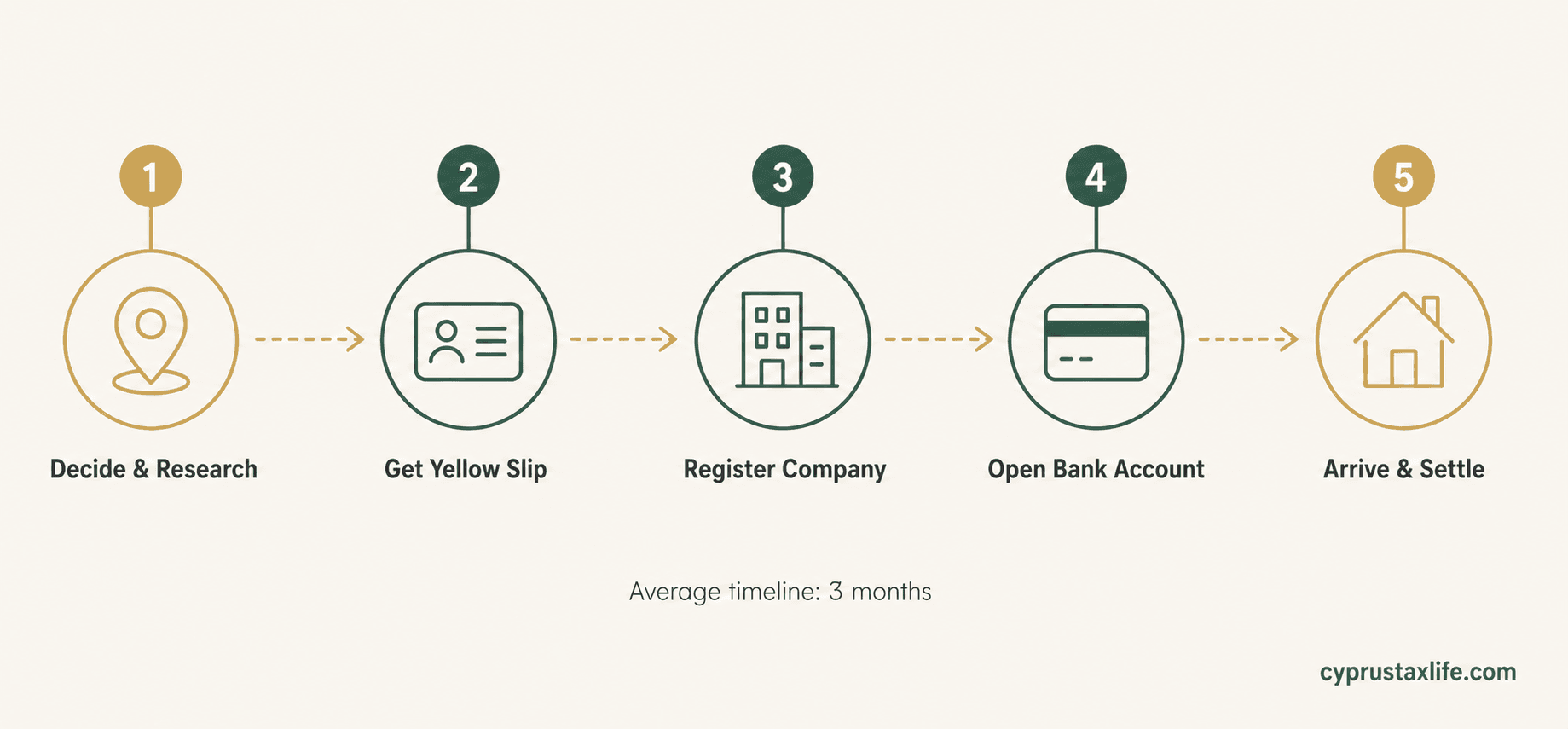
Step-by-Step Relocation Checklist
Research Cyprus cities and connect with the Italian expat community in Cyprus
Set up a Cyprus Ltd company (approximately EUR 2,100)
Find accommodation in Cyprus and sign a rental contract
Register with AIRE (Anagrafe degli Italiani Residenti all'Estero) at your Italian municipality or Italian consulate
File cessation notifications with INPS and close your Partita IVA with Agenzia delle Entrate
File your final Italian IRPEF tax return for the departure year
Close INAIL coverage if applicable
Apply for Cyprus tax residency (60-day or 183-day rule)
Register for Non-Dom status at the Cyprus Tax Department
Obtain your Yellow Slip (EU citizen registration)
Open a Cyprus bank account
Register for GHS healthcare
Set up payroll structure in Cyprus (low salary + dividends)
Inform Italian banks of your new tax residency status
Frequently Asked Questions
Does Italy have an exit tax when leaving?+
What is AIRE and do I need to register?+
How does the Italian flat tax regime for non-residents compare to Cyprus?+
Can I keep my Italian SRL after moving to Cyprus?+
How much can I save by moving from Italy to Cyprus?+
Sources and References
- PwC Worldwide Tax Summaries — Cyprus
- KPMG Cyprus — Tax and Advisory
- EY Cyprus — Tax Services
- Cyprus Ministry of Finance (mof.gov.cy)
Effective rates are approximations for entrepreneur structures (company + low salary + dividends). Consult a qualified tax advisor before making decisions.
Free, no commitment
Does this apply to your situation?
Tell us your situation and we'll connect you with our specialist expat advisory firm in Cyprus. They have years of experience managing relocations like yours.
Related Articles
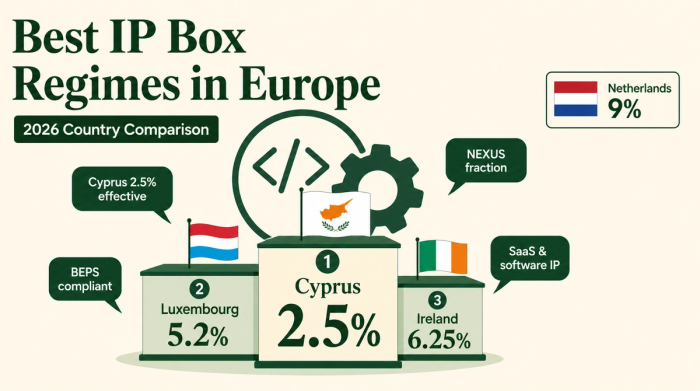
Compare the best IP box regimes in Europe: Cyprus 2.5%, Luxembourg 5.2%, Ireland 6.25%, Netherlands 9%. NEXUS rules, qualifying IP, and which regime suits SaaS and software companies.
 Miriam Alonso
- Tax Planning
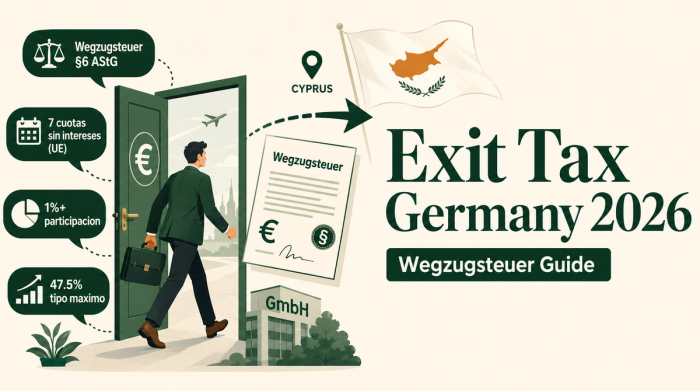
Germany's Wegzugsteuer applies to GmbH shareholders with 1%+ stake who have been resident for 10+ years. Learn the rates, the 7-instalment EU option, and how Cyprus interacts with it.
Miriam Alonso- Tax Planning

The Dutch exit tax (conserverende aanslag) applies to substantial shareholdings and pension rights when you leave. Learn rates, EU deferral rules, and how Cyprus interacts with it.
Miriam Alonso- Tax Planning