Cyprus vs Dubai: Tax, Living and Business Compared
Dubai has 9% corporate tax above AED 375k and 0% income tax. Cyprus Non-Dom matches ~5% effective while staying in the EU. Which is better for your business in 2026?
Last updated: 2026-04-27
Effective tax rate comparison
~0-9%
Dubai (UAE)
~5%
Cyprus Non-Dom
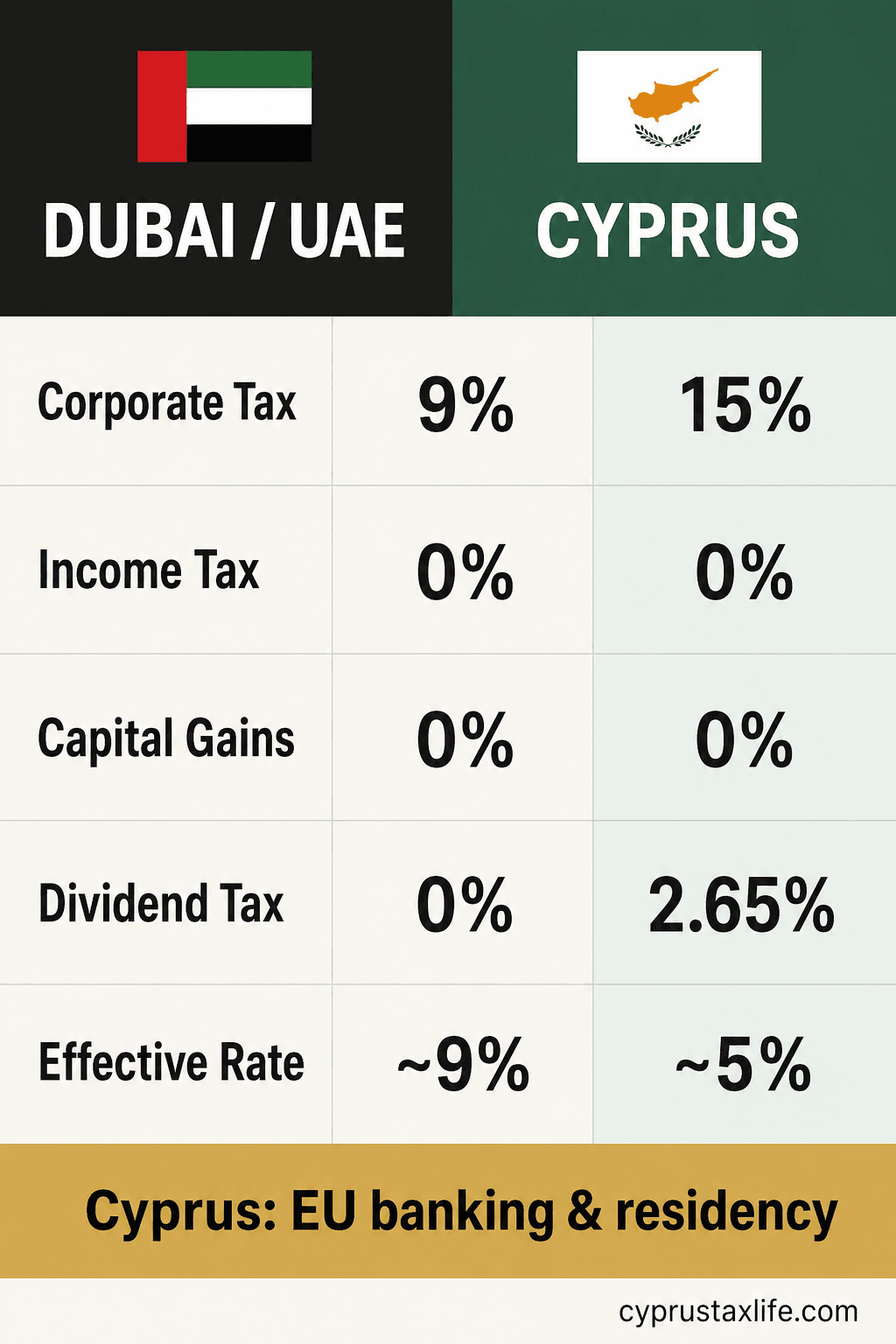
Tax Comparison: Dubai (UAE) vs Cyprus
| 🇦🇪 Dubai (UAE) | 🇨🇾 Cyprus (Non-Dom) | |
|---|---|---|
| Corporate tax | 9% (above AED 375,000 profit) | 15% |
| Income tax | 0% | 0% (dividends) |
| Capital gains tax | 0% | 0% (no Cyprus property) |
| Dividend tax | 0% | 0% income tax + 2.65% GHS |
| Wealth tax | None | None |
| Social contributions | None for expats | ~4% on salary (capped) |
| Effective rate (entrepreneur) | ~0-9% | ~5% |
| VAT | 5% | 19% |
Tax Burden in Dubai (UAE)
Dubai (part of the United Arab Emirates) introduced a federal corporate tax in June 2023 at a rate of 9% on taxable profits above AED 375,000 (approximately EUR 93,000). Profits below this threshold are taxed at 0%. Small Business Relief is available for businesses with revenue below AED 3 million (approximately EUR 750,000), allowing them to elect to pay 0% until at least 2026.
There is no personal income tax in the UAE. No capital gains tax, no dividend tax, no wealth tax, and no social security contributions for expatriate workers (UAE nationals pay GPSSA contributions). VAT is 5%, introduced in 2018.
Free Zone companies (established in one of Dubai's 40+ free zones like DMCC, DIFC, DAFZA) are typically taxed at 0% if they conduct qualifying activities within the free zone and meet substance requirements. However, free zone companies cannot serve UAE mainland clients without a mainland license or local agent.
The UAE's inclusion on the EU list of non-cooperative jurisdictions (Annex I, "blacklist") and the FATF grey list in 2024 has created increased compliance scrutiny for UAE-based companies. Many EU banks require enhanced due diligence for UAE companies and individuals. Substance requirements under the UAE's ESR (Economic Substance Regulations) are strict and require demonstrable real activity in the UAE.
Why Cyprus is Better for Entrepreneurs
Dubai and Cyprus are both low-effective-rate jurisdictions, but they serve very different business profiles. The choice depends fundamentally on your client base, banking needs, and personal lifestyle preferences.
For EU-focused businesses, Cyprus is clearly superior. A Cyprus Ltd maintains full EU single market access, benefits from EU directives, can invoice EU clients without friction, and is recognized by all EU banks as a standard EU company. Dubai, by contrast, has faced increased scrutiny from EU banks since the FATF listing, and some European financial institutions apply additional compliance requirements to UAE entities.
Tax comparison: UAE effective rate 0-9%, Cyprus effective rate approximately 5%. The tax difference is minimal or non-existent. What differs are the non-tax factors: EU access, banking ease, cost of living, and lifestyle.
For entrepreneurs with no EU client base (primarily serving Asian, Middle Eastern, or global markets), Dubai may be preferable. The UAE's 0% personal income tax, strong infrastructure, and strategic location between East and West are genuine advantages. For those with EU clients or banking relationships, Cyprus is the better base.
UAE residency requires spending meaningful time in the UAE and meeting minimum day requirements. Cyprus's 60-day rule is more flexible.
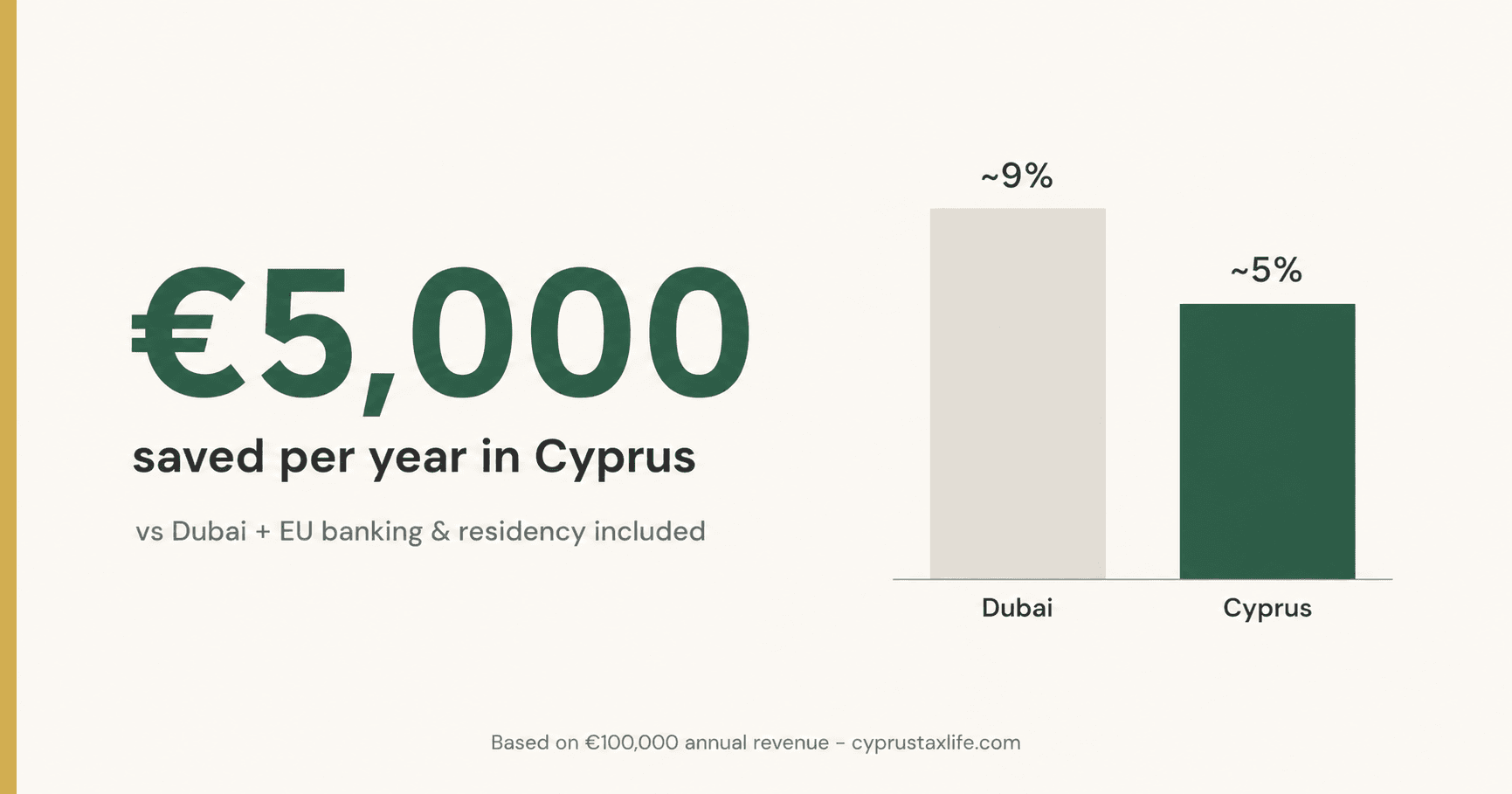
Tax Calculation: EUR 100,000
🇦🇪 Dubai (UAE)
🇨🇾 Cyprus (Non-Dom)
Annual savings moving to Cyprus
EUR 4,000
EUR 20,000 over 5 years
Double Tax Treaty: Dubai (UAE) - Cyprus
Cyprus and the UAE (including Dubai) have a double tax treaty in force. Key withholding rates: dividends 0%, interest 0%, royalties 0%. This is an excellent treaty for cross-border structuring between the two jurisdictions. Cyprus's extensive treaty network (65+) also provides global coverage that the UAE (with approximately 130+ treaties) matches in breadth. For businesses operating between Europe and the Middle East, both Cyprus and the UAE offer good treaty protection.
Exit Tax and Emigration from Dubai (UAE)
The UAE does not impose an exit tax. Leaving Dubai is straightforward: cancel your residency visa, close your company (if applicable), and deregister with the relevant authorities. There is no capital gains tax on share disposals, no dividend tax to plan around, and no retrospective charges. For entrepreneurs moving FROM Dubai to Cyprus, the transition is administratively simple, though establishing genuine Cyprus residency and complying with the 60-day rule (or 183-day rule) is important for avoiding any UAE tax authority disputes.
Cost of Living: Dubai (UAE) vs Cyprus
Dubai is significantly more expensive than Cyprus in most categories. Monthly rent for a 2-bedroom apartment: Dubai Marina or Downtown EUR 2,000-4,000, suburban Dubai EUR 1,200-2,000. Cyprus: Larnaca EUR 550-750, Limassol EUR 650-900. Groceries in Dubai are similar to Cyprus (both import much of their food). Dining out ranges widely but quality restaurants charge EUR 80-150 for two in Dubai vs EUR 30-45 in Cyprus. School fees in Dubai are very high (EUR 15,000-30,000 per year for international schools). Healthcare is excellent but requires private insurance (EUR 1,000-3,000/year for families).
The combined tax + lifestyle cost comparison: in Dubai, you pay less tax (0-9%) but more for everything else. In Cyprus (~5% tax), costs are much lower. For high earners, Dubai's total cost of living can be 2-3 times that of Cyprus, eliminating much of the apparent tax advantage.
Practical Steps to Relocate
Evaluate your client base: EU-focused (choose Cyprus) or global/Middle East (consider Dubai)
For Cyprus: establish a Cyprus Ltd (5-7 working days, EUR 2,100)
Apply for Cyprus tax residency (60-day or 183-day rule)
Register as Non-Dom at the Cyprus Tax Department
Obtain a Yellow Slip or residency permit
Open a Cyprus bank account
For Dubai: establish a UAE Free Zone or mainland company
Apply for UAE residency visa
Open a UAE business bank account (increasing compliance requirements from EU banks)
Consider your banking relationships: if your clients pay in EUR and use EU banks, Cyprus banking is more seamless
Frequently Asked Questions
Is Dubai or Cyprus better for an entrepreneur?+
Is the UAE on the EU blacklist?+
Can I live in Cyprus part-time and Dubai part-time?+
Does Dubai have the 9% corporate tax on free zone companies?+
Which has better banking - Cyprus or Dubai?+
What are the substance requirements for UAE vs Cyprus?+
Sources and References
Tax data: PwC Worldwide Tax Summaries, KPMG Tax Guides (2025/2026), Big Four country guides, government tax authority publications. Effective rates are approximations for entrepreneur structures (company + low salary + dividends). Consult a qualified tax advisor before making decisions.
Free, no commitment
Does this apply to your situation?
Tell us your situation and we'll connect you with our specialist expat advisory firm in Cyprus. They have years of experience managing relocations like yours.
Related Articles
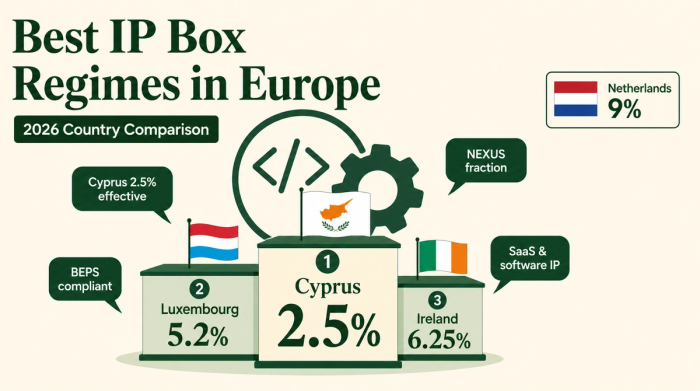
Compare the best IP box regimes in Europe: Cyprus 2.5%, Luxembourg 5.2%, Ireland 6.25%, Netherlands 9%. NEXUS rules, qualifying IP, and which regime suits SaaS and software companies.
 Miriam Alonso
- Tax Planning
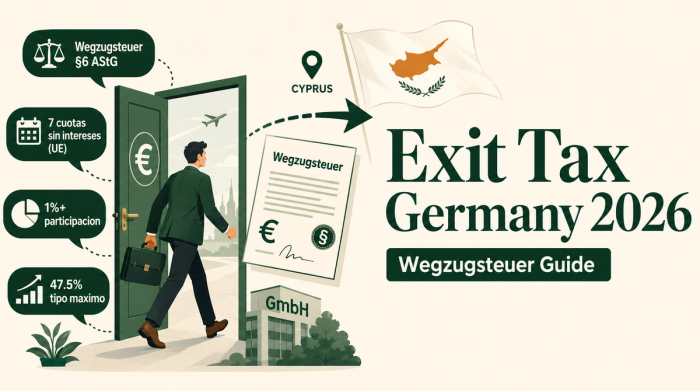
Germany's Wegzugsteuer applies to GmbH shareholders with 1%+ stake who have been resident for 10+ years. Learn the rates, the 7-instalment EU option, and how Cyprus interacts with it.
Miriam Alonso- Tax Planning

The Dutch exit tax (conserverende aanslag) applies to substantial shareholdings and pension rights when you leave. Learn rates, EU deferral rules, and how Cyprus interacts with it.
Miriam Alonso- Tax Planning