Cyprus vs Portugal 2026: After NHR, Which Is Better for Entrepreneurs?
Portugal abolished NHR for new applicants in Jan 2024. The IFICI replacement covers barely anyone. Cyprus Non-Dom offers ~5% effective with no 10-year limit vs Portugal's 42-48%. Full 2026 comparison.
Last updated: 2026-06-01
Effective tax rate comparison
~42-48%
Portugal
~5%
Cyprus Non-Dom
Which Is Better For You?
Remote worker / freelancer
Cyprus wins clearly. Portugal's NHR ended in 2024 and the IFICI replacement covers only researchers and certified startup founders — not general freelancers or remote workers. Without NHR, Portugal taxes at 42-48% effective. Cyprus Non-Dom: ~5%. Annual saving on EUR 100,000: ~EUR 37,000-43,000.
Holding company / IP owner
Cyprus wins. Portugal has 21% corporate tax plus 28% dividend tax. Cyprus has 15% corporate, 0% dividend income tax (Non-Dom). For a holding company distributing profits to a founder, Cyprus saves EUR 37,000-43,000 per year on EUR 100,000 of distributed income.
Retiree / passive investor
Portugal wins for retirees who had NHR (10% flat tax on foreign pensions for 10 years). For new retirees who cannot get NHR, Portugal taxes pensions at standard IRPF rates (up to 48%). Cyprus offers a 5% flat rate option on foreign pensions — better than Portugal's standard rate, and competitive even with the old NHR.
Crypto investor
Cyprus wins. Portugal taxes crypto gains at 28% (held less than 1 year) or taxed as income for frequent traders. Cyprus introduced an 8% flat rate for professional traders in 2026, and 0% CGT for individual investors. Cyprus is clearly better for crypto.
Tax Comparison: Portugal vs Cyprus
| 🇵🇹 Portugal | 🇨🇾 Cyprus (Non-Dom) | |
|---|---|---|
| Corporate tax | 21% + 1.5% municipal surcharge | 15% |
| Income tax | Up to 48% + solidarity surcharge 2.5-5% | 0% (dividends) |
| Capital gains tax | 28% | 0% (no Cyprus property) |
| Dividend tax | 28% | 0% income tax + 2.65% GHS |
| Wealth tax | None | None |
| Social contributions | ~11% employee + ~23.75% employer | ~4% on salary (capped) |
| Effective rate (entrepreneur) | ~42-48% | ~5% |
| VAT | 23% | 19% |
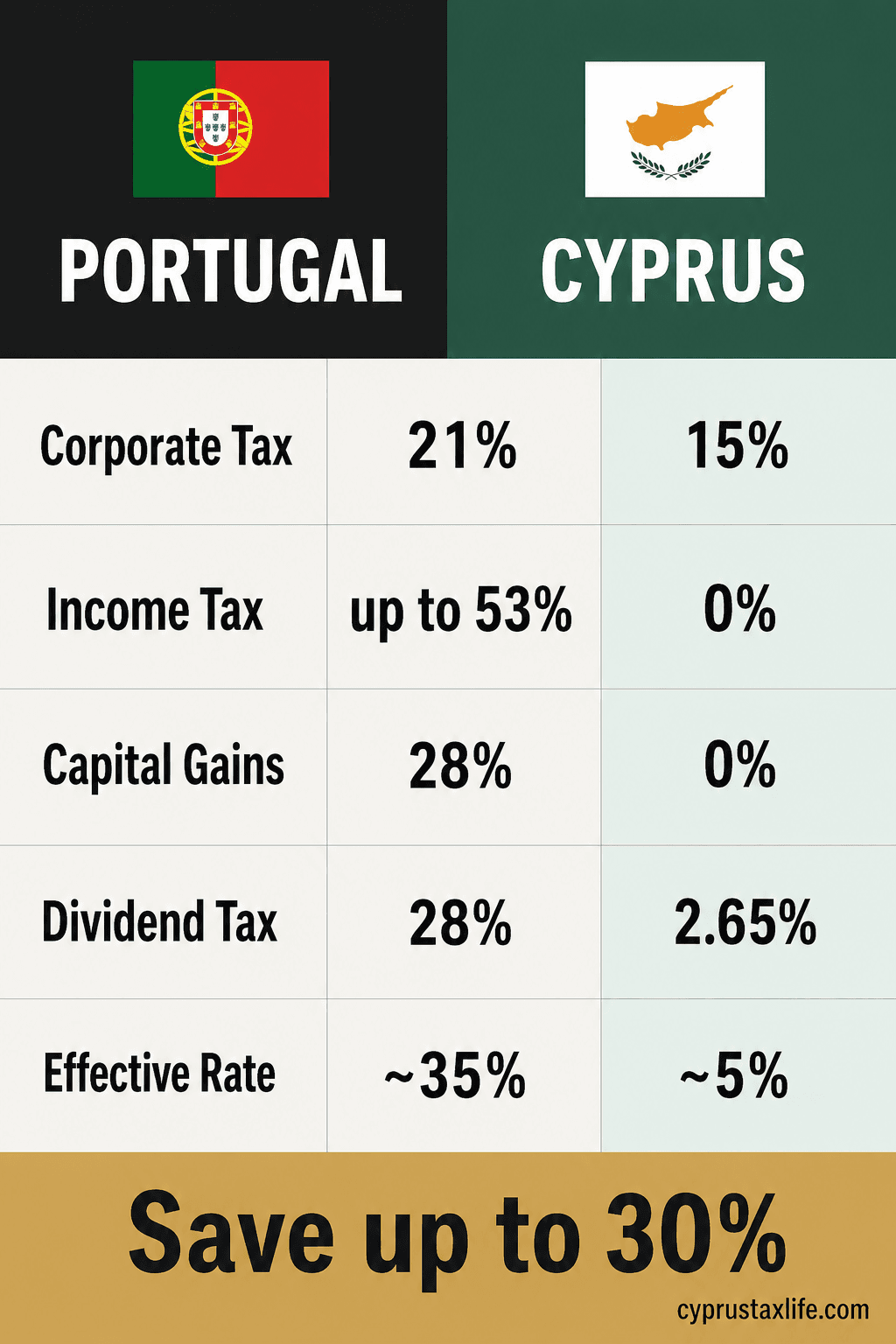
Tax Burden in Portugal
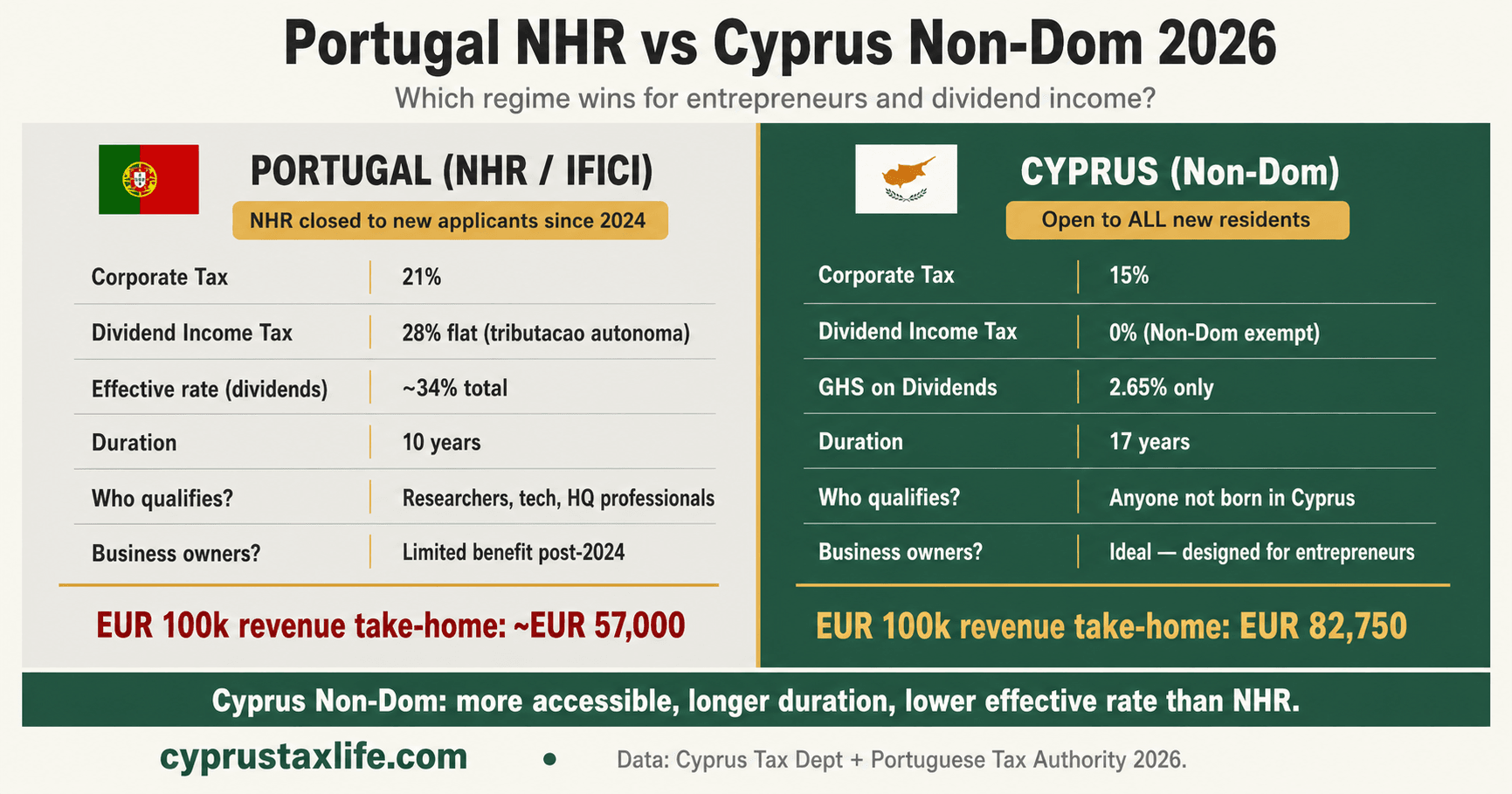
Portugal was a popular destination for entrepreneurs and digital nomads thanks to the NHR (Non-Habitual Resident) regime, which offered a 20% flat rate on certain income for 10 years. However, the NHR was abolished for new applicants from January 2024. Those who applied before the deadline maintain their status until the 10-year period expires.
Without NHR, Portugal applies its standard tax system. The IRC (Imposto sobre o Rendimento das Pessoas Coletivas) corporate tax is 21% at the national level, plus a 1.5% municipal surcharge (derrama municipal) applied by most municipalities, and a state surcharge (derrama estadual) of 3-9% on profits above EUR 1.5 million. For most SMEs, the effective corporate rate is 22.5%.
Dividends are taxed at a flat 28% (PFU equivalent, the "taxa liberatoria"). Combined with 22.5% corporate tax, the total on distributed profits reaches approximately 44-45%.
Social security contributions are high: employees pay 11% and employers 23.75%. Self-employed ("trabalhadores independentes") pay contributions of approximately 21.4% on 70% of declared income. The IRPF (personal income tax) is progressive to 48%, with a solidarity contribution of 2.5% on income above EUR 80,000 and 5% above EUR 250,000.
Portugal introduced a replacement for NHR called the IFICI (Incentivo Fiscal a Investigacao Cientifica e Inovacao) in 2024, targeting qualifying researchers, tech professionals, and certain entrepreneurs. This offers a 20% flat rate for 10 years but has strict eligibility requirements - and critically, most expats cannot qualify.
The IFICI is explicitly limited to nine specific categories: scientific research, highly qualified professionals in technology and innovation, founders of startups certified by IAPMEI, and a handful of other narrowly defined roles. It does NOT apply to: retirees, passive investors living off dividends or rental income, general freelancers, remote workers in non-qualifying sectors, or entrepreneurs running non-tech companies. The vast majority of expats who were drawn to Portugal by the NHR fall outside these categories entirely.
Why Cyprus is Better for Entrepreneurs
For entrepreneurs whose NHR period is expiring or who cannot qualify for IFICI, Cyprus is the natural next destination. Cyprus Non-Dom provides similar (or better) tax benefits with no time limit.
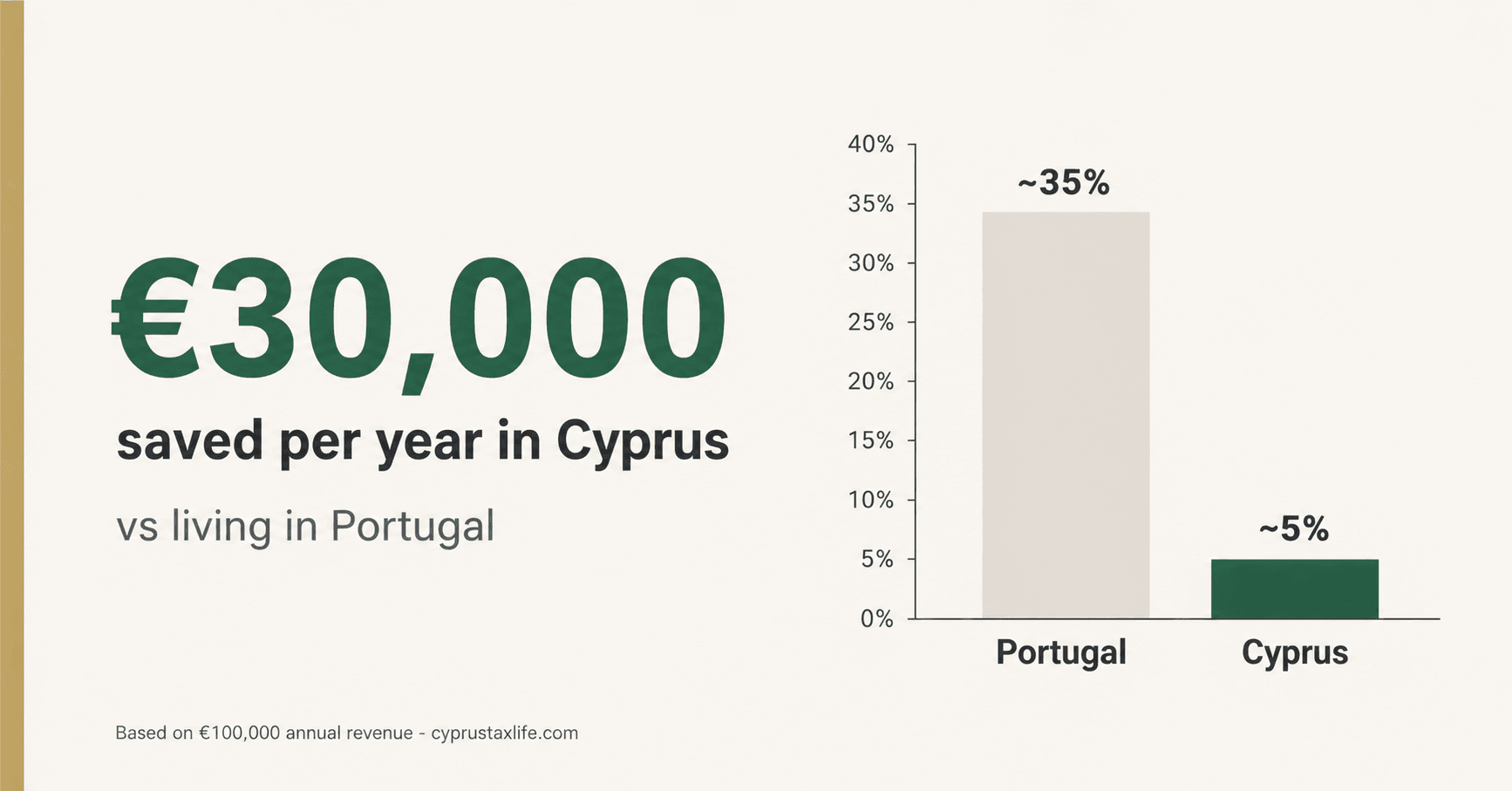
The comparison is stark: Portugal without NHR at 42-48% effective vs. Cyprus Non-Dom at ~5%. Annual savings on EUR 100,000 of revenue: approximately EUR 37,000-43,000. Over 5 years: EUR 185,000-215,000.
Even compared to the old NHR regime (20% flat on qualifying income), Cyprus Non-Dom at ~5% is significantly better. And critically, Cyprus Non-Dom has no 10-year expiry - it lasts as long as you are a Cyprus tax resident who was not a Cyprus resident for 17 of the previous 20 years.
Portugal and Cyprus are both EU members, offering comparable EU single market access, VAT OSS registration, and freedom of movement. Both have Mediterranean climates, though Cyprus is warmer and drier. Banking options are broader in Cyprus. Lisbon and Porto are more expensive than Larnaca or Limassol.
Tax Calculation: EUR 100,000
🇵🇹 Portugal
🇨🇾 Cyprus (Non-Dom)
Annual savings moving to Cyprus
EUR 39,200
EUR 196,000 over 5 years
Double Tax Treaty: Portugal - Cyprus
Portugal and Cyprus have a double tax treaty in force. Key withholding rates: dividends 10-15%, interest 10%, royalties 10%. EU directives can reduce these rates to 0% for qualifying corporate structures. The treaty follows OECD principles with standard tie-breaker rules. Portuguese entrepreneurs moving to Cyprus should ensure they cleanly establish Cyprus tax residency, as Portugal aggressively pursues tax evaders who claim to have emigrated but maintain strong Portuguese connections.
Exit Tax and Emigration from Portugal
Portugal does not have a formal exit tax for individuals comparable to Germany or France. However, gains realized in the departure year are taxable under the standard capital gains rules. Real estate in Portugal remains subject to Portuguese taxation regardless of your residency. The transition from NHR to a standard Portuguese taxpayer (or emigration) requires careful timing of income recognition and dividend distributions.
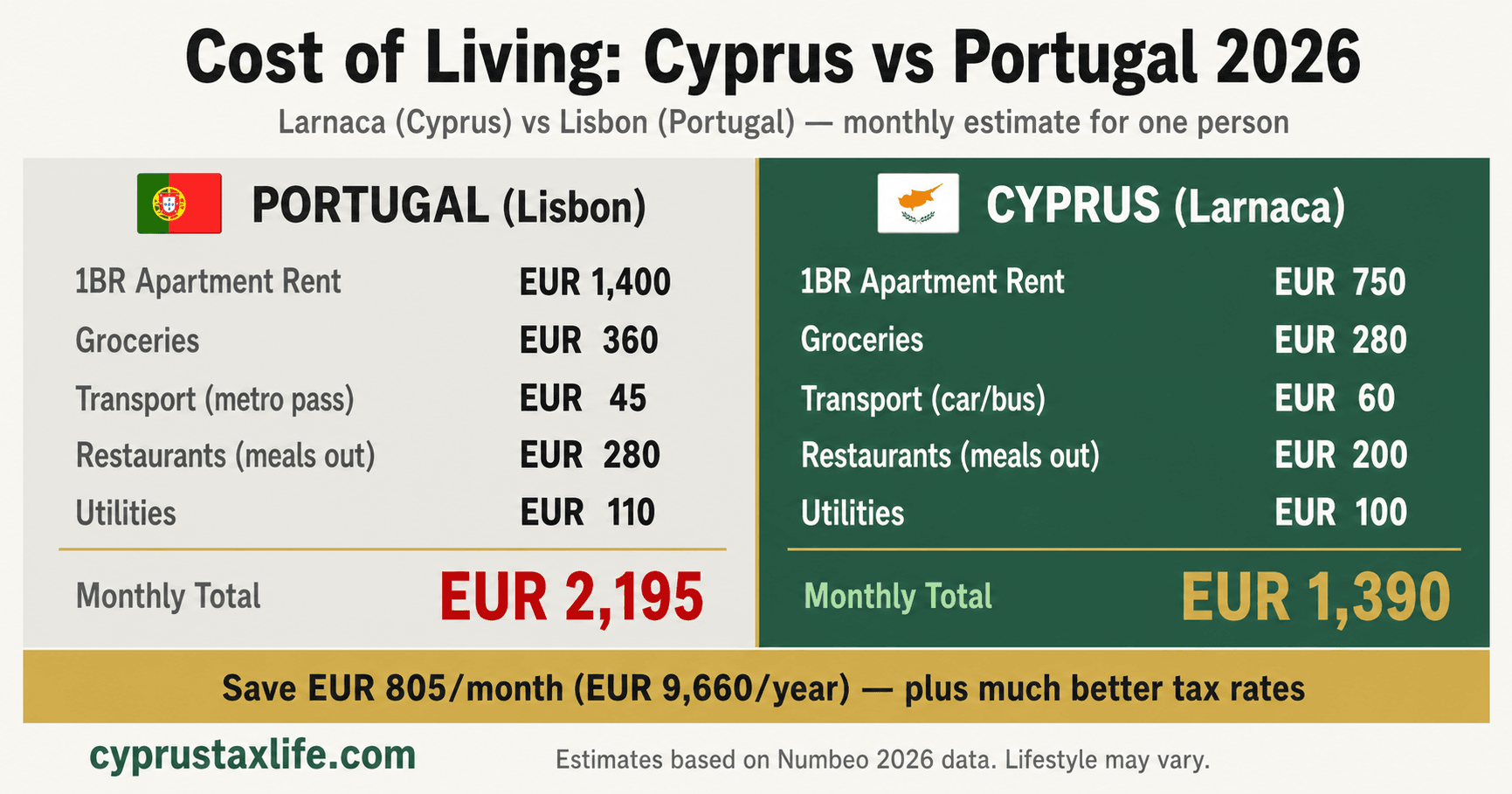
Cost of Living: Portugal vs Cyprus
Cost of living comparison is nuanced. Lisbon and Porto have become expensive, with 2-bedroom apartment rents reaching EUR 1,400-2,200 in popular areas. The Algarve is EUR 900-1,500. Smaller Portuguese cities and the interior are comparable to Cyprus. Cyprus (Larnaca EUR 550-750, Limassol EUR 650-900) is generally cheaper than Lisbon but comparable to medium-sized Portuguese cities. Food and dining are comparable in both countries. Both offer high quality of life with Mediterranean climate. Portuguese winters are milder and wetter; Cyprus summers are hotter and drier.
Practical Steps to Relocate
Determine your NHR status: are you currently in the programme (check expiry), or starting fresh?
Establish a Cyprus Ltd company (5-7 working days, approximately EUR 2,100)
Deregister from Portugal (Portal das Financas - submit change of fiscal domicile)
File your last Portuguese IRS return
Deregister from Seguranca Social
Apply for Cyprus tax residency
Register as Non-Dom at the Cyprus Tax Department
Obtain your Yellow Slip (EU citizen registration)
Open a Cyprus bank account
Restructure or close any Portuguese entities (Lda, unipessoal)
Set up GHS contributions and payroll in Cyprus
Frequently Asked Questions
Is the NHR still available in Portugal?+
Does Cyprus Non-Dom expire like the NHR?+
Can I move from Portugal to Cyprus and keep serving Portuguese clients?+
What about Portuguese real estate?+
How does the quality of life compare between Cyprus and Portugal?+
Is there a Portuguese-speaking community in Cyprus?+
Sources and References
Tax data: PwC Worldwide Tax Summaries, KPMG Tax Guides (2025/2026), Big Four country guides, government tax authority publications. Effective rates are approximations for entrepreneur structures (company + low salary + dividends). Consult a qualified tax advisor before making decisions.
Free, no commitment
Moving to Cyprus or opening a company?
Tell us your situation and we'll connect you with our specialist expat advisory in Cyprus: Non-Dom tax, company setup and residency, done for you. Free consultation, no commitment.
Related Articles
Germany's exit tax (§6 AStG) taxes unrealised gains on shares >1% when you emigrate. Moving to Cyprus (EU): you can defer payment indefinitely. Full breakdown for German founders and investors.
 Miriam Alonso
- Tax Planning
- Relocation
Canada's departure tax treats you as having sold your worldwide assets the day you stop being a tax resident. What is caught, what is exempt, how to defer it, and what the cost-base reset means for where you go next.
![Countries With No Property Tax [2026]: The Real Cost](https://cdn.sanity.io/images/glqahhks/production/6f7ea0efceed8a692ad7c3785efa8baaf4d1e208-1679x937.jpg?w=700&q=75&auto=format)
Compare countries with no property tax and the stamp duty they charge instead. See the 10-year holding cost that makes Cayman pricier than Portugal.
Miriam Alonso