Cyprus vs Malta: Tax, Costs and Business Compared
Malta 6/7 refund reaches ~5% effective but costs EUR 8,000-15,000/year in compliance and requires 183 days residency. Cyprus Non-Dom hits the same 5% with EUR 3,000-5,000/year and only 60 days.
Last updated: 2026-04-27
Effective tax rate comparison
~5-15%
Malta
~5%
Cyprus Non-Dom
Tax Comparison: Malta vs Cyprus
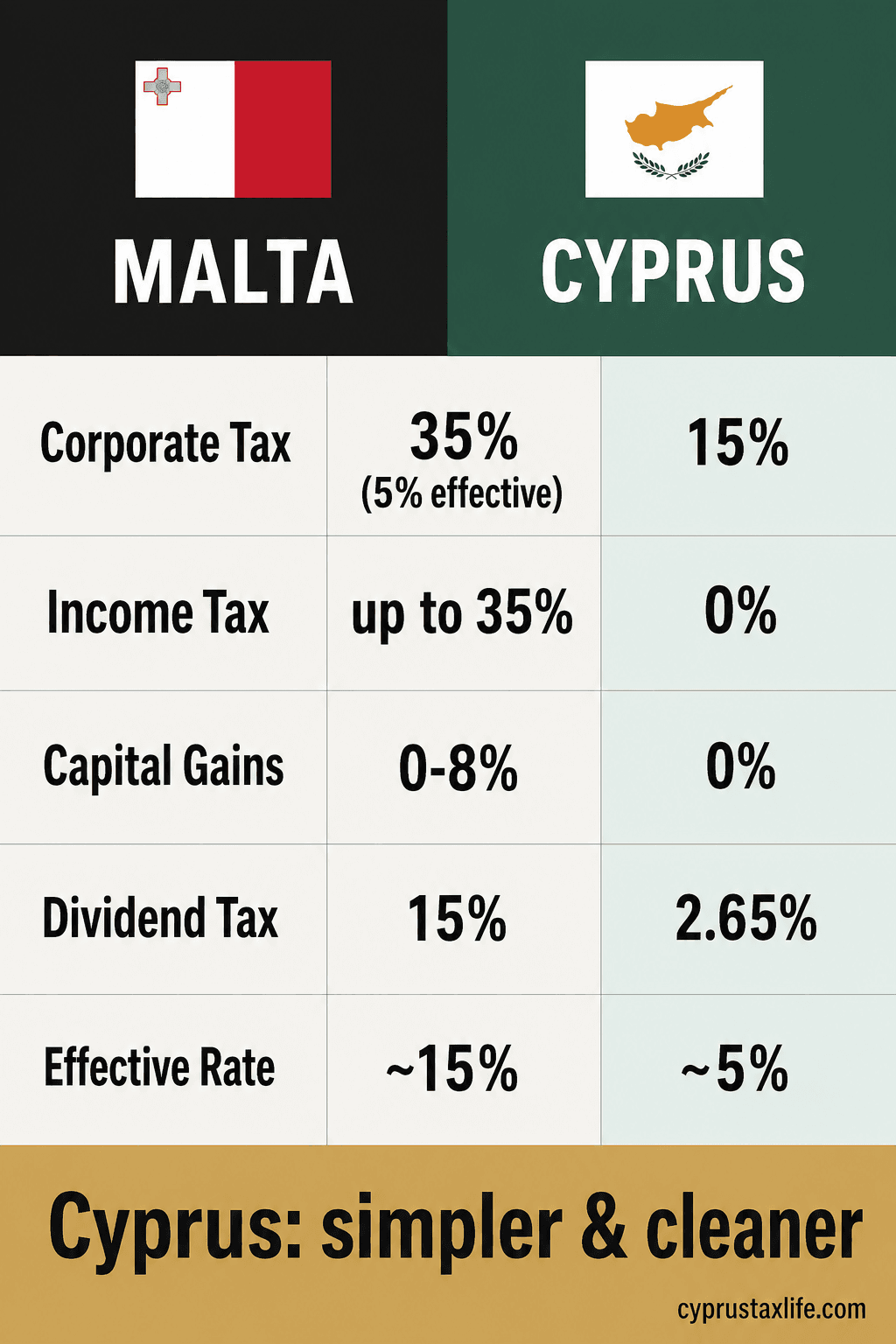
| 🇲🇹 Malta | 🇨🇾 Cyprus (Non-Dom) | |
|---|---|---|
| Corporate tax | 35% statutory (5% effective via 6/7 refund) | 15% |
| Income tax | Up to 35% | 0% (dividends) |
| Capital gains tax | 0-8% (on property; shares usually exempt) | 0% (no Cyprus property) |
| Dividend tax | 0% (refund system) | 0% income tax + 2.65% GHS |
| Wealth tax | None | None |
| Social contributions | 10% employee + 10% employer (capped) | ~4% on salary (capped) |
| Effective rate (entrepreneur) | ~5-15% | ~5% |
| VAT | 18% | 19% |
Tax Burden in Malta
Malta has a unique corporate tax system built around a refund mechanism. The statutory corporate tax rate is 35%, but shareholders of a Malta company can claim a refund of 6/7 of the tax paid when dividends are distributed from trading income, reducing the effective rate to approximately 5%. For passive income (interest, royalties), the refund is 5/7, giving an effective rate of 10%.
This 6/7 refund system requires a Maltese holding company structure and a non-resident shareholder. The refund must be applied for and takes time to process (typically several months after filing). The process involves: Maltese operating company pays 35% tax, distributes dividends, shareholder claims 30/35 refund, leaving an effective 5% rate.
For personal income, Malta applies progressive rates up to 35%. The Highly Qualified Persons (HQP) regime offers a flat 15% rate for qualified professionals in specific sectors. The Global Residence Programme offers a minimum 15% on remitted income. Social contributions are relatively low at 10% each for employer and employee, capped at a reasonable amount.
The key difference compared to Cyprus: Malta's low effective rate is achieved through a refund mechanism that requires a two-tier structure, refund applications, and more compliance. The substance requirements are also increasing under OECD BEPS pressure.
Why Cyprus is Better for Entrepreneurs
Both Cyprus and Malta achieve approximately 5% effective corporate tax rates, but the paths are very different. Cyprus reaches 5% through the Non-Dom exemption on dividends directly, while Malta requires a 35% statutory tax followed by a 6/7 refund claim.
The practical differences matter: in Cyprus, you structure salary + dividends with 15% corporate tax and 0% dividend tax (Non-Dom). No refund applications, no waiting periods, no two-tier structures needed. In Malta, you need at least a Maltese company + a non-resident holding structure, and you wait for the refund to arrive.
Annual compliance costs differ significantly. A Malta structure with the 6/7 refund requires two entities, annual audits (mandatory in Malta), company secretary fees, and tax refund filings - total annual cost typically ranges from EUR 8,000 to EUR 15,000. A Cyprus Ltd with Non-Dom requires one entity and straightforward annual accounting - total annual cost typically ranges from EUR 3,000 to EUR 5,000. The compliance saving alone is EUR 5,000-10,000 per year.
Residency requirements also differ. To qualify for Malta's tax regime, you typically need to establish genuine residence and spend at least 183 days per year in Malta. Cyprus offers the 60-day rule: spending just 60 days per year in Cyprus (without being resident in any other country for 183+ days) qualifies for full tax residency and Non-Dom. For digital nomads or those who want flexibility to spend time in multiple countries, this is a decisive difference.
Banking in Cyprus is easier for international businesses. Cyprus has more double tax treaties (65+) compared to Malta (70+, though Malta's network is strong). Both are EU members.
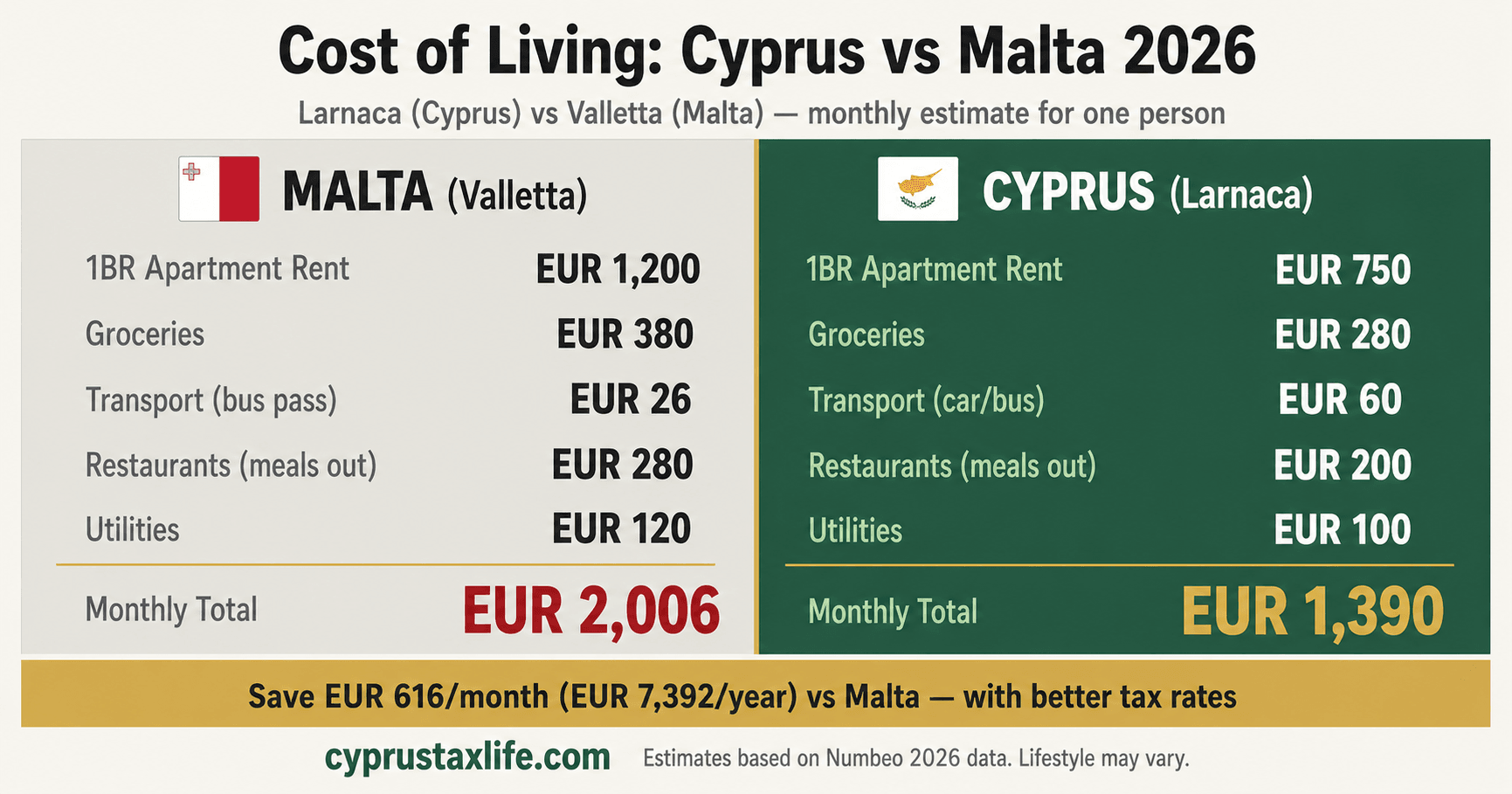
Cost of living strongly favors Cyprus: Malta has become expensive due to its tiny land area and high demand. Valletta and the surrounding areas have rents approaching EUR 1,200-1,800 for 2-bedroom apartments - significantly higher than Larnaca or even Limassol. Cyprus offers more space, lower costs, and comparable quality of life.
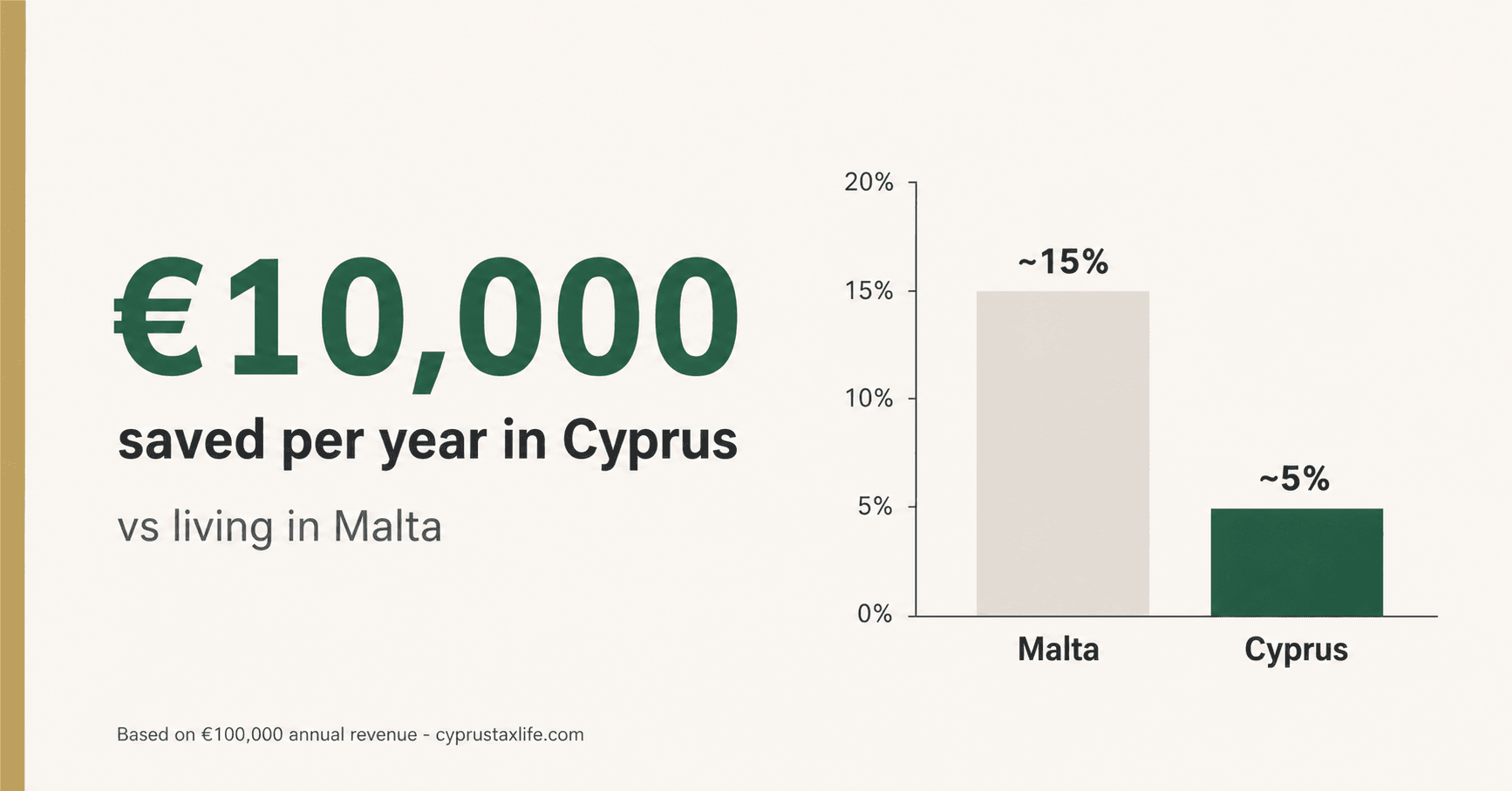
Tax Calculation: EUR 100,000
🇲🇹 Malta
🇨🇾 Cyprus (Non-Dom)
Annual savings moving to Cyprus
EUR 7,000
EUR 35,000 over 5 years
Double Tax Treaty: Malta - Cyprus
Cyprus and Malta do not have a bilateral tax treaty between them. However, as EU members, both benefit from EU directives (parent-subsidiary directive, interest and royalties directive) that reduce or eliminate withholding taxes on intra-EU payments. Cyprus has 65+ treaties with third countries and Malta 70+. For entrepreneurs choosing between the two, the treaty network is broadly comparable, with some differences in specific countries covered.
Exit Tax and Emigration from Malta
Malta does not impose an exit tax on individuals emigrating. Company relocations may trigger tax considerations but the process is generally straightforward. For entrepreneurs moving between Malta and Cyprus (or vice versa), the main considerations are timing of dividend distributions, managing the refund process for existing Maltese companies, and ensuring clean transition of tax residency. Malta's global residence programmes typically require giving up the programme benefits if you leave.
Cost of Living: Malta vs Cyprus
Cyprus is notably cheaper than Malta across most categories. Malta has experienced significant cost inflation due to its small size and high demand. Rent in Malta: EUR 1,200-1,800 for a 2-bedroom apartment in Valletta/Sliema area, EUR 900-1,300 in other areas. Cyprus: EUR 550-750 in Larnaca, EUR 650-900 in Limassol. Dining out is 20-30% more expensive in Malta. Both countries have Mediterranean climates, though Cyprus is hotter and drier in summer. Malta is smaller (316 km2 vs 9,251 km2), more densely populated, and offers less countryside and natural scenery. Cyprus has more space, more beaches, and a greater variety of landscapes.
Practical Steps to Relocate
Compare your specific situation: are you moving from Malta to Cyprus, or evaluating where to incorporate?
If moving from Malta: review your existing Maltese company structure and outstanding refund applications
Establish a Cyprus Ltd company (5-7 working days, approximately EUR 2,100)
Apply for Cyprus tax residency (60-day rule or 183-day rule)
Register as Non-Dom at the Cyprus Tax Department
Get your Yellow Slip (EU citizen registration)
Open a Cyprus bank account
Deregister your Maltese tax residence
Close or restructure Maltese entities if applicable
Transfer healthcare coverage to Cyprus GHS
Frequently Asked Questions
Is Malta or Cyprus better for company formation?+
Does the Malta 6/7 refund system still work?+
Is Malta on the EU blacklist?+
Which country has a better quality of life?+
How long does the Malta tax refund take?+
Can I use the Non-Dom concept in Malta?+
Sources and References
Tax data: PwC Worldwide Tax Summaries, KPMG Tax Guides (2025/2026), Big Four country guides, government tax authority publications. Effective rates are approximations for entrepreneur structures (company + low salary + dividends). Consult a qualified tax advisor before making decisions.
Free, no commitment
Does this apply to your situation?
Tell us your situation and we'll connect you with our specialist expat advisory firm in Cyprus. They have years of experience managing relocations like yours.
Related Articles
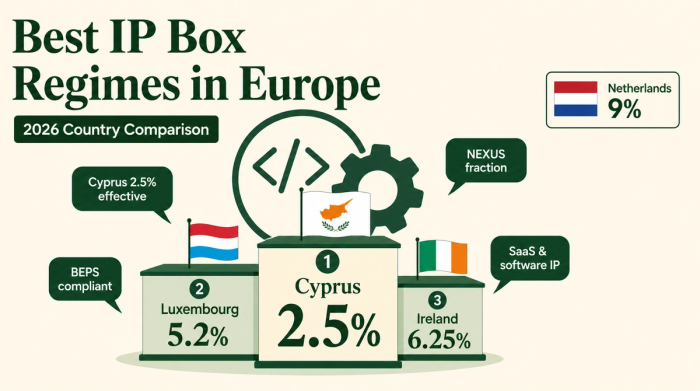
Compare the best IP box regimes in Europe: Cyprus 2.5%, Luxembourg 5.2%, Ireland 6.25%, Netherlands 9%. NEXUS rules, qualifying IP, and which regime suits SaaS and software companies.
 Miriam Alonso
- Tax Planning
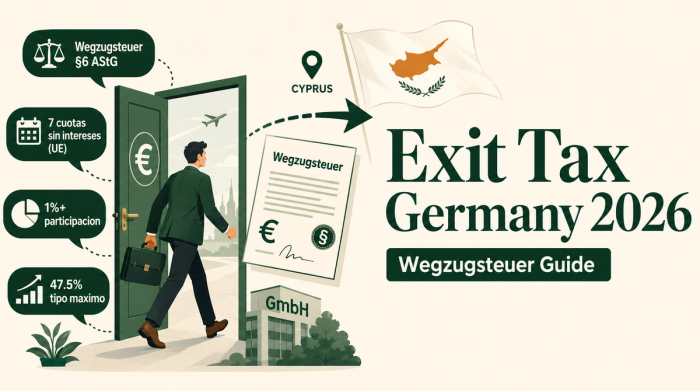
Germany's Wegzugsteuer applies to GmbH shareholders with 1%+ stake who have been resident for 10+ years. Learn the rates, the 7-instalment EU option, and how Cyprus interacts with it.
Miriam Alonso- Tax Planning
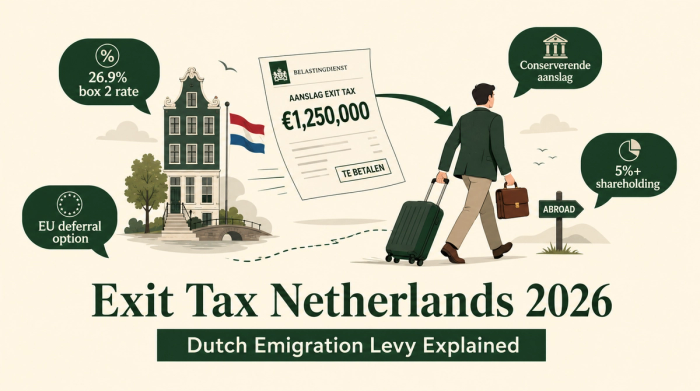
The Dutch exit tax (conserverende aanslag) applies to substantial shareholdings and pension rights when you leave. Learn rates, EU deferral rules, and how Cyprus interacts with it.
Miriam Alonso- Tax Planning